


Key takeaways
- UTC is the common reference point; offsets are usually written as UTC+5 or UTC−8.
- Daylight saving time changes the offset, not the time zone name.
- Some regions do not observe daylight saving.
- A time difference can cross midnight and change the date.
- For recurring meetings, check the offset again after a daylight-saving change.
What a time zone really is
A time zone is a region that shares the same clock time. The offset is how far that local time is from Coordinated Universal Time (UTC). New York, for example, is UTC−5 in winter and UTC−4 in summer. London is UTC+0 in winter and UTC+1 in summer.
Time zone names can be ambiguous. “Eastern Time” can mean standard time or daylight time. Offsets are more precise for calculation, but they change with daylight saving. The safest approach is to check the offset for the specific date.
The conversion method
- Write the source time with its offset.
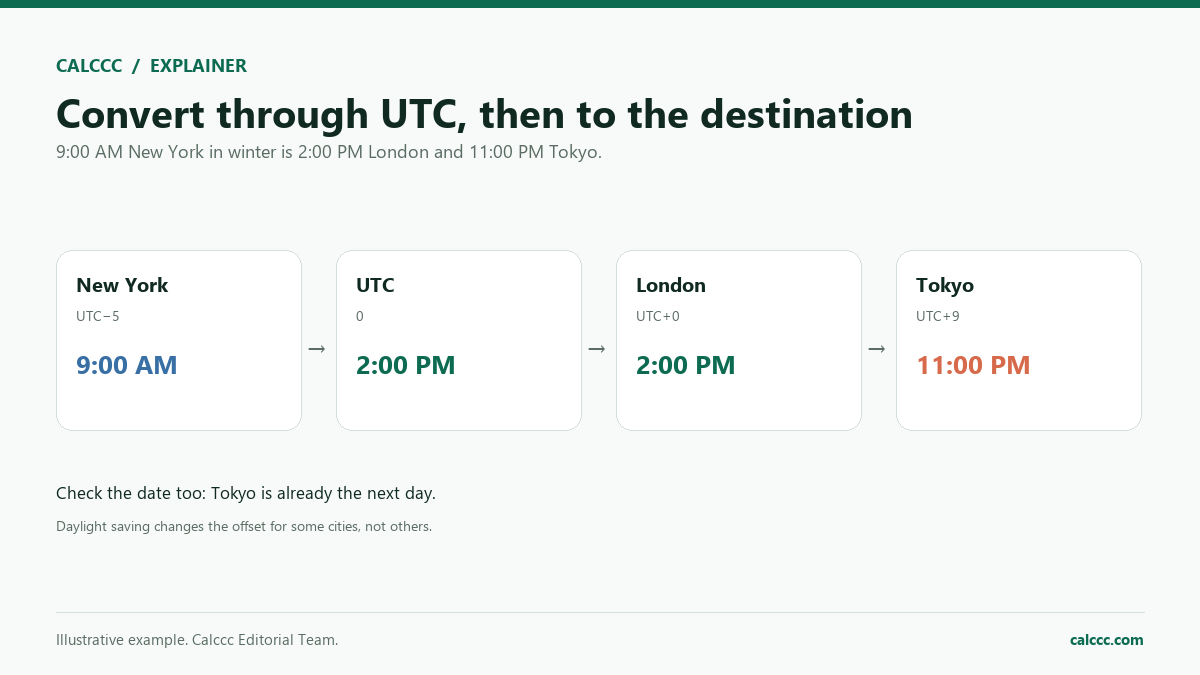
- Convert the source time to UTC: if the offset is +5, subtract 5 hours; if it is −8, add 8 hours.
- Apply the destination offset: add if the destination is ahead of UTC, subtract if it is behind.
- Adjust the date if the result crosses midnight.
Example: 9:00 AM in New York on a winter date (UTC−5) is 2:00 PM UTC. In London on a winter date (UTC+0), it is 2:00 PM. In Tokyo (UTC+9), it is 11:00 PM the same date. In Sydney (UTC+11 in summer), it is 1:00 AM the next day.
Daylight saving is the trap
Daylight saving time shifts clocks forward in spring and back in autumn. The offset changes, but the time zone name often stays the same. Two dates a few weeks apart can have different offsets. If you schedule a recurring meeting, confirm the offset for each occurrence or use a calendar that handles time zones.
Regions near the equator often do not observe daylight saving. Some countries have changed their rules or abolished it. A conversion that was correct last year may be wrong this year.
Date line and cross-midnight conversions
When the destination offset is far ahead, the converted time may be on the next calendar day. When it is far behind, it may be the previous day. Do not just compare clock times; check the date. A Monday 9:00 AM meeting in New York can be Tuesday in Tokyo.
Common offset examples
| Location | Winter offset | Summer offset |
|---|---|---|
| New York | UTC−5 | UTC−4 |
| London | UTC+0 | UTC+1 |
| Tokyo | UTC+9 | UTC+9 (no DST) |
| Sydney | UTC+11 (southern summer) | UTC+10 (southern winter) |
Offsets can change by jurisdiction and year. Use a reliable converter or the IANA time zone database for current rules.
Why “time zone” and “offset” are not the same
A time zone is a named region with a set of rules; an offset is a number. Two places can share an offset but have different daylight-saving rules. A place can change its offset without changing its name. For calculations, use the offset for the specific date; for display, use the time zone name.
2026 calculator update: what changed
The linked calculator has been upgraded. It now includes a professional worksheet with the inputs used, the method and scope, and a one-variable sensitivity check for finance tools. You can save two input sets as Scenarios A/B and compare the results side by side. The Print / PDF action produces a branded worksheet, and table-producing calculators can export a CSV.
UTC offsets
Time zones are offsets from UTC. New York is UTC−5 in winter and UTC−4 in summer; London is UTC+0 or UTC+1. A conversion must include the date, because the offset can change at 2 a.m. local time. Use the IANA zone name, not a fixed abbreviation, for daylight-saving transitions.
Meeting example
A 9 a.m. Monday meeting in New York is 2 p.m. London, 3 p.m. Berlin, and 11 p.m. Tokyo. The date can differ: a 9 a.m. Monday New York meeting is 11 p.m. Monday Tokyo, but a 9 a.m. Monday Tokyo meeting is 8 p.m. Sunday New York. Always show the date.
What to compare
Compare the UTC instant, the local time, and the date. A conversion that ignores DST or the date line can be off by an hour or a day.
Frequently asked questions
Is UTC the same as GMT?
They are often used interchangeably in everyday contexts. UTC is the modern standard; GMT is a time zone name. For most scheduling, the difference is not material.
Does the date always change?
No, only when the conversion crosses midnight. Check the result rather than assuming it is the same day.
Why did my meeting move by an hour?
One location changed to or from daylight saving time. The offset changed even though the time zone name may not have.
What about time zones with half-hour offsets?
Some regions use 30- or 45-minute offsets. Include the exact offset in the calculation; do not round to the nearest hour.
How we checked this guide
We converted the example by hand using the winter offsets, then checked the result with the time zone converter. The IANA time zone database is the technical reference for current rules, and NIST provides the UTC standard. Daylight-saving rules can change; verify the date-specific offset.
Further reading