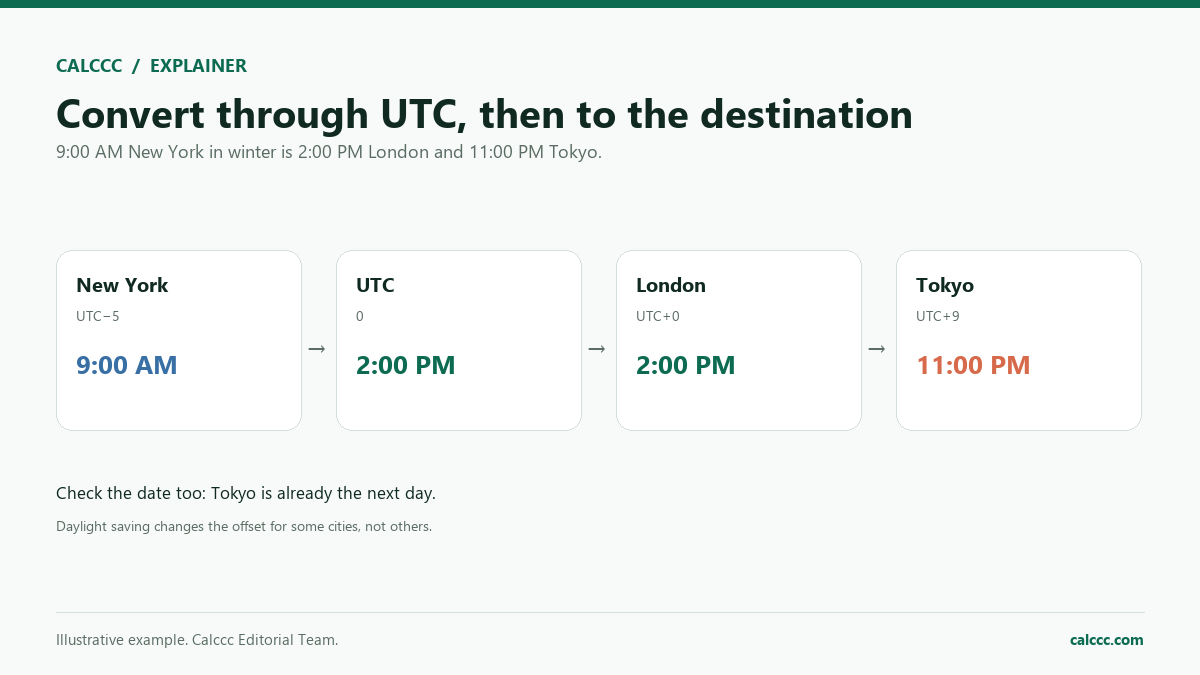
What this calculator does
A time zone is a region that keeps the same clock offset from UTC. Converting between zones looks simple until daylight saving time shifts an offset by an hour, usually on different dates in different countries. This converter supports ten common zones and works through UTC, so the result is consistent even when the source and target change their clocks on different weekends. It also reports the day shift, because a meeting can land on tomorrow's date across the Pacific.
How to use it
- Enter the date in year-month-day form.
- Enter the hour from 0 to 23 and the minute from 0 to 59.
- Choose the time zone the time is in.
- Choose the time zone you want to convert to.
- Read the converted local time, the UTC time, and any day shift.
How it works
Example calculations
Example 1: 2026-11-07 12:00 New York to London
US daylight time ended on November 1, so New York is UTC-5 and noon is 17:00 UTC. London is back on GMT at UTC+0, so the result is 17:00 on the same day. The day shift is zero.
Example 2: 2026-01-15 09:30 Los Angeles to Tokyo
Los Angeles is on Pacific Standard Time, UTC-8, so 09:30 is 17:30 UTC. Tokyo is UTC+9 all year, which makes the result 02:30 on January 16. The day shift is plus one.
Example 3: 2026-07-01 18:00 London to Sydney
London is on British Summer Time, UTC+1, so 18:00 is 17:00 UTC. Sydney is on Australian Eastern Standard Time, UTC+10, in July, so the result is 03:00 on July 2. The day shift is plus one.
What the result means
The UTC line is the anchor: it never changes with daylight saving, so it is the safest value to share across countries. The local result is what the target clock will read. Watch the day shift when the gap crosses midnight, common for US to Asia or Europe to Australia calls. Also watch the weeks when one country has changed its clocks and another has not. Each spring and fall, New York and London are four hours apart for a short window instead of the usual five. Sydney moves the opposite way because its summer falls in the Southern Hemisphere, while Shanghai and Tokyo stay fixed all year.
Common mistakes
- Assuming every time zone observes daylight saving time.
- Adding the target offset to the source local time without going through UTC first.
- Forgetting that the calendar date can change along with the hour.
- Using a summer offset to plan a winter meeting.
- Confusing the abbreviations EST and EDT, or GMT and BST.
Assumptions and limits
- The date falls in 2026 and current time zone rules apply to it.
- Each selected zone follows the daylight saving rules in force on that date.
- Leap seconds and historical rule changes are not modeled.
- The entered time is a wall-clock time in the source zone.
- All supported offsets are whole hours.
Frequently asked questions
Why does noon in New York become 17:00 in London in November?
New York is five hours behind UTC in November, and London is on UTC+0, so noon New York is 17:00 UTC and 17:00 London.
Can the date change after conversion?
Yes. A large eastward gap often pushes the result past midnight. The calculator reports a plus-one or minus-one day shift when that happens.
What is UTC?
Coordinated Universal Time is the reference clock that time zones are defined against. It does not shift for daylight saving.
Does Shanghai observe daylight saving time?
No. China uses one zone, UTC+8, all year. Tokyo is also UTC+9 all year, so both are simple to convert.
How far ahead is Sydney in July?
Sydney is UTC+10 in July, its winter. It switches to UTC+11 for its summer, from October to early April.
What about a zone that is not listed?
This page supports ten zones. For others, find the zone's offset from UTC for that specific date and apply the same two-step method.
Sources
2026 update
How to use the professional output
This page is not just a formula box. The result is designed to be checked, compared, and taken away.
- Professional worksheet. The result includes the inputs used, the method and scope, and a one-variable sensitivity check for finance calculators.
- A/B scenarios. Save two input sets in the browser and compare the primary, secondary, and breakdown figures side by side.
- Print / PDF and CSV. Print a branded worksheet, or export the year-by-year table when the calculator produces one.
The formulas and assumptions above still govern the number. The worksheet makes the estimate auditable; it does not make it a lender quote, tax return, or personalized advice.
Go deeper