


Key takeaways
- Presses commute. Pressing A then B has the same result as B then A.
- Never press twice. Two presses on the same square cancel each other.
- Chase the top row. Use row two to turn off the lights left on in row one.
- Repeat downward. Each row fixes the row above it.
- Not every board is solvable. The Calccc generator starts from a solved board, so its boards always are.
The rule, precisely
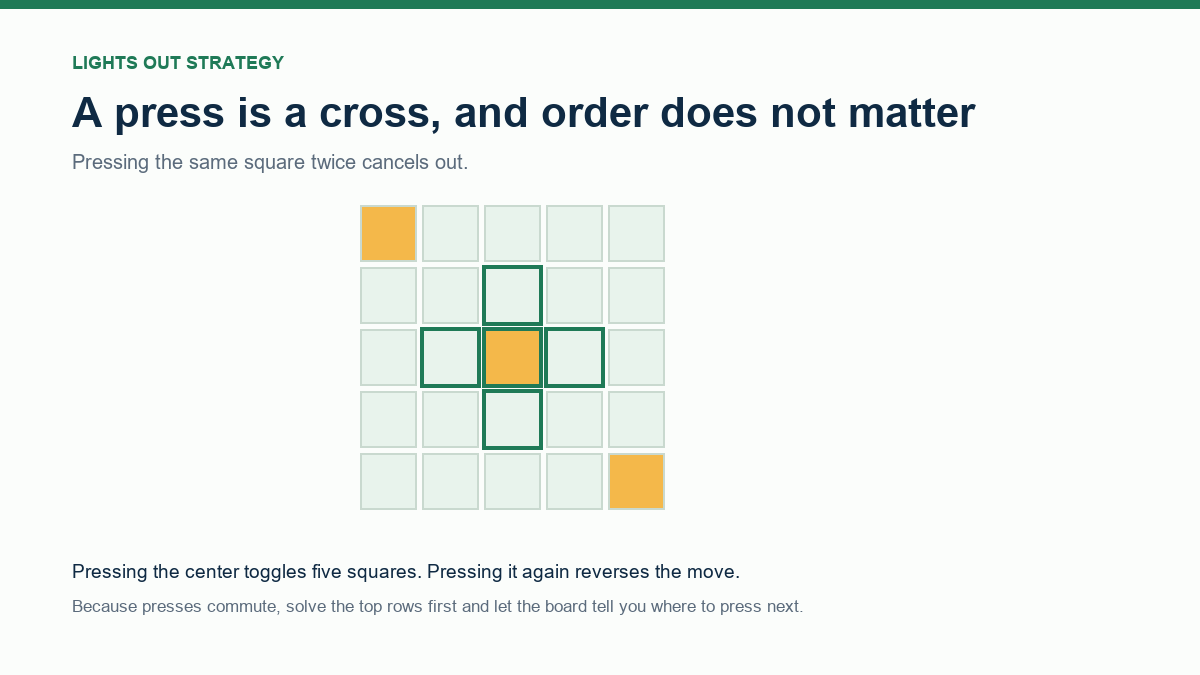
Lights Out is played on a grid of lights. Pressing a square toggles that square and its four orthogonal neighbours: up, down, left, and right. A diagonal neighbour is not affected. The goal is to turn every light off.
On a 5×5 board, one press changes five squares (or fewer at the edge, because some neighbours are outside the grid). The board state is binary: each light is either on or off. Pressing the same square a second time reverses the first press, so a solution never needs to press a square more than once.
Why order does not matter
Each press is a fixed operation on the board. If you press A and then B, the final state is the starting state with A applied and B applied. Applying B first and A second gives the same result, because both operations are toggles and toggles commute. This is the key insight that turns a confusing puzzle into a procedure.
It also means the solution is a set of squares to press, not a sequence. You can press them in any order. The only thing that matters is whether each square is pressed an odd or even number of times. Pressing twice is the same as not pressing at all.
The top-row chase
Here is the standard method for a 5×5 board:
- Look at the first row. If a light is on, press the square directly below it in the second row.
- Move across the first row from left to right, fixing every light.
- When the first row is off, move to the second row. Use the third row to turn off any lights left on in the second row.
- Repeat for rows three and four.
- After the fifth row is used, look at the bottom row. On a solvable board, it is already off. On an unsolvable board, some lights remain and no further row exists to fix them.
The chase works because pressing below a light is the only way to toggle it without disturbing the already-solved row above. Pressing a square in the same row would also change its left and right neighbours, which you have already fixed. The row below is the only clean tool.
What happens at the bottom
The procedure always clears rows one through four. The bottom row is the test. If it is off, you have solved the board. If it is not, the initial board was not solvable by this chase, which means it is not in the solvable subspace for that grid size. You cannot fix it by pressing more squares in the bottom row without breaking the row above; a different first-row pattern would be needed.
This is why some Lights Out boards are impossible. The game has a linear structure: each press is a vector over the two-element field, and the reachable states form a subspace. On some grid sizes, not every configuration is reachable. The Calccc generator starts from an all-off board and applies random presses, so every generated board is guaranteed solvable.
Why the 3×3 board is special
On a 3×3 board, the chase is short. Solve the first row, then use the second row, then the third. The same logic applies, but the board is small enough to see the whole pattern. A useful exercise is to start from a single lit corner and find the set of presses that clears it. The solution is not the corner itself; it is a small cross pattern that includes the corner and its neighbours.
Do not memorise a list of 3×3 solutions. Instead, practise the chase and watch how each press changes the next row. The procedure scales to 5×5 and 7×7 without new rules.
Lights Out in 2026: short daily sessions
Lights Out fits the daily-puzzle format unusually well: the board is small, the rule is one sentence, and the solve is over quickly. The Calccc version has Mini, Classic, Expert, and Daily modes. The daily board is the same for everyone, which turns a solitary toggle puzzle into a shared little challenge without a timer or an account.
Use the Mini to learn the top-row chase, then try the Daily without the hint. If you use the hint, replay the board and see whether you can explain why the first row changed.
Common mistakes
Pressing randomly. Every press changes five squares, so a random press usually creates more work. Pressing the same square twice. It cancels, which means the move was wasted. Solving the bottom row first. The chase depends on fixing rows from the top; starting at the bottom breaks the invariant. Assuming every board is solvable. If the final row cannot be cleared, the board may be unsolvable; restart rather than thrashing.
Practice
The Calccc Lights Out has Mini 3×3, Classic 5×5, Expert 7×7, and Daily 5×5. Start with 3×3 and say the rule out loud: press below the light. Then move to 5×5 and use the top-row chase without undo. If you get stuck, undo one move and check whether you pressed a square twice or skipped a row.
Frequently asked questions
Is Lights Out always solvable?
A randomly generated board is not guaranteed to be solvable from every state. Calccc generates solvable boards from a known press pattern, so the puzzle has a valid solution.
What is the best first move in Lights Out?
Work from the top row. Once the first row is fixed, the presses in the second row are forced by the lights left on above them.
Further reading