


Key takeaways
- One corner is home. The largest tile should stay in a corner while you build toward it.
- Keep a lane. Use one row or column for small tiles so merges do not block the corner.
- Down and left are usually enough. Extra directions create disorder.
- Daily boards are shared. Same start, same spawn sequence, one clean attempt.
- Variants change the goal. Fibonacci and Sprint boards need different planning.
Why the board gets stuck
Most failed 2048 boards are not beaten by a lack of arithmetic. They are beaten by a shape problem. A large tile drifts into the middle, small tiles surround it, and every move either breaks the corner or fills the last empty lane. The fix is to treat the board as a container with a fixed large-tile corner, not as a collection of numbers to merge wherever possible.
The corner-and-lane method
Choose a corner, usually bottom-left, and decide that the largest tile will live there. Keep the bottom row ordered, with the largest value nearest the corner and smaller values extending to the right. When the row is full, merge upward and rebuild the row. The top rows are working space; the bottom row is the completed shelf.
Use Down as the main move and Left as the ordering move. Right and Up are rescue moves, not routine moves. Every time you press Up, you create a new row above the shelf and make it easier for a large tile to escape. Every time you press Right, you push the shelf away from the corner.
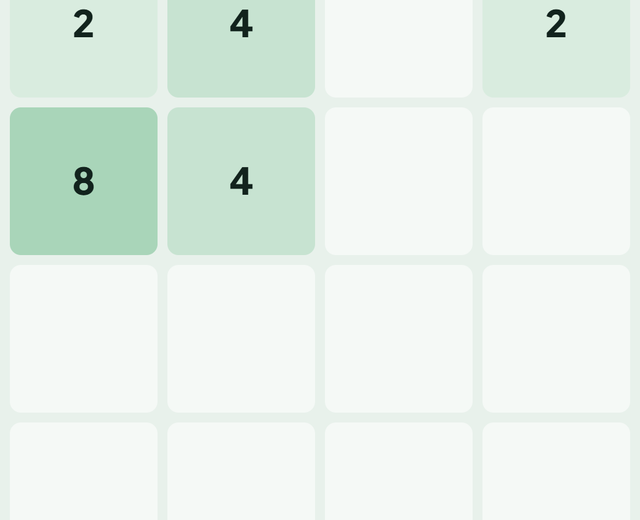
Reading the next spawn
The next tile appears in a random empty cell, but the risk is predictable. After a merge, count the empty cells in the working rows. If only one or two remain, do not merge the shelf; rebuild the small tiles first. A 2 that appears in the wrong place is easy to absorb; a 2 that blocks the only lane can end the run.
When to use the other directions
Use Up when the working rows are nearly empty and the shelf is stable. Use Right when the bottom row has a gap on the left and no large tile is at risk. The point is not to ban directions; it is to make them deliberate. If you cannot say why you are pressing Up, do not press it.
Fibonacci 2584
Fibonacci mode changes the merge rule: adjacent values merge when they are consecutive Fibonacci numbers, not equal numbers. A 1 next to a 2 becomes 3; a 3 next to a 5 becomes 8. The same corner method works, but the lane must be ordered by the Fibonacci sequence. Do not assume a 2 and a 2 will merge; they will not.
Sprint 3×3
Sprint is a smaller board with a lower target. It is a good training mode because every wasted move is visible. On 3×3, the corner is tighter and the working space is smaller, so the order of merges matters more. Use Sprint to practise clean sequences, then return to 4×4.
Daily boards and the 2026 habit
Daily 2048 uses a seeded start so everyone gets the same board. That turns the game into a short shared challenge: one attempt, one score, no answer to spoil. The daily format is useful for measuring improvement because the opening is constant. Play the same amount of time each day rather than grinding unlimited boards.
A five-minute practice routine
Play one daily board without undo, then replay the first twenty moves on a fresh Classic board. The replay is where the learning happens: you can see whether the first large tile stayed in the corner and whether the small-tile lane survived the first merge. Do not chase a personal best every session. One clean shape is a better session than three messy high scores.
If you are stuck at a plateau, lower the target. Sprint 3×3 reaches its goal quickly, so a single bad move is obvious. Once Sprint feels controlled, return to 4×4 and apply the same corner discipline with more room.
2026 variant: Obstacle 4×4
The new Obstacle board blocks the four centre cells. The corner-and-lane method still applies, but the blocked cells split the board into corridors. Keep the largest tile in a corner, use the open edge row as the lane, and avoid pressing toward a wall that has no exit. The blocked cells also reduce the number of spawn cells, so the board fills faster.
Common mistakes
Chasing every merge. A merge that breaks the shelf is not free. Letting the largest tile leave the corner. Once it moves, the board rarely recovers. Using all four directions. More directions mean more disorder. Ignoring the last empty lane. The lane is a resource; protect it.
Practice
Play the Calccc 2048 Classic board, then try Daily for a shared start, Fibonacci for a different merge rule, and Sprint for a short, unforgiving round. The best practice is one focused board, not ten distracted ones.
Corner strategy
Keep the largest tile in a corner and build a descending row along one edge. Avoid moving the corner tile unless the board forces it. The blocked-cell variant splits the board, so choose the lane with the most open space.
What to compare
Compare the corner stability, the empty cells, and the next spawn risk. A high tile without a stable lane can be lost quickly.
Frequently asked questions
What is the best first move in 2048?
Pick a corner and keep the largest tile there. Use Down and Left as your main moves; treat Up and Right as rescue moves.
Does Daily 2048 use the same board for everyone?
Yes. Daily mode uses a seeded start, so the opening board and spawn sequence are shared for that date.
Further reading