


Key takeaways
- Scan before you write. A single in a row, column, or box is the cheapest move.
- Notes are memory, not clutter. Write candidates only when they help you compare cells.
- Variants add one rule. X adds diagonals; Killer adds cage sums; Fog hides cells until revealed.
- Daily boards build a comparison habit. Same puzzle, no spoilers, one attempt.
- Guessing is a last resort. If you guess, mark the branch so you can undo it cleanly.
The core loop
Pick a digit and scan. Ask where that digit can go in a row, a column, and a 3×3 box. If only one cell remains, place it. Then scan the next digit. This sounds slow, but it prevents the most common beginner error: filling a cell because it looks plausible, then spending ten minutes repairing the board.
When singles run out, switch to candidate notes. A cell with two candidates is a fork; a row with two cells that both accept the same two digits is a pair. Pairs eliminate those digits from the other cells in the row, column, or box. The goal is to reduce the board until a single appears again.
X-Sudoku
X-Sudoku adds two diagonals that must also contain 1–9. Treat each diagonal as an extra region. A digit that already appears on a diagonal is eliminated from the remaining diagonal cells. Start with the center cell: it belongs to both diagonals, so it is often the most constrained cell on the board.
Killer Sudoku
Killer Sudoku replaces some givens with cages: dashed outlines with a target sum. A cage of two cells that sums to 3 must be 1+2; a cage of two that sums to 17 must be 8+9. Learn the small unique combinations first, then use the 45 rule: every row, column, and box sums to 45. If a house is almost covered by cages, the remaining cells have a forced sum.
Fog of War
Fog of War hides cells until you place a correct digit. The visible area grows as you solve. This variant rewards safe, local deductions: a hidden cell cannot be used in a scan, so concentrate on the revealed region and avoid speculative placements that would expand the fog incorrectly. If a placement feels like a guess, wait for a cleaner single.
Daily Sudoku
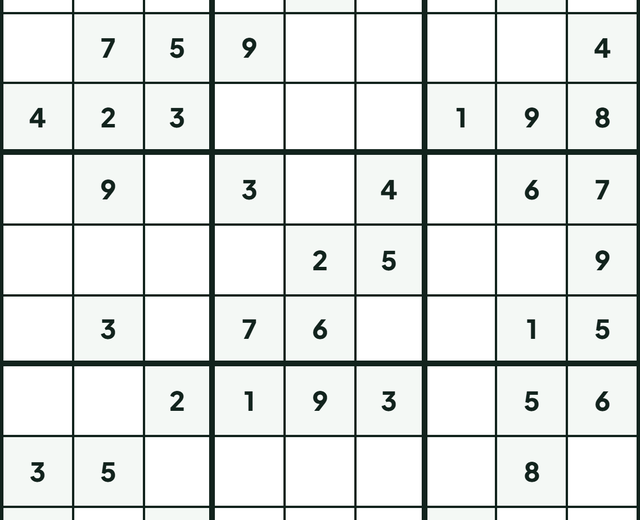
Daily Sudoku uses a seeded board so every player sees the same puzzle. The value is not just the puzzle; it is the ritual. One board, one attempt, then compare your time or your route. The daily board is also a good difficulty sample: if you finish it comfortably, move to X or Killer; if it takes repeated guessing, return to Classic and practise singles.
A 2026 variant ladder
The current sudoku audience is more variant-literate than the classic-only era. A sensible ladder is Classic 9×9 → Mini 6×6 for a quick reset → X-Sudoku for one extra region → Killer for arithmetic constraints → Fog for a different information model. Do not jump into Killer before you can solve a Classic board without notes; the cage arithmetic is easier when the basic scan is automatic.
How to practise without guessing
Set a rule for the session: no digit goes into a cell unless you can name the row, column, box, diagonal, cage, or fog deduction that forces it. If you break the rule, undo the guess and write the candidate instead. This is slower at first, but it builds the exact skill that variants require. A guessed Classic board teaches nothing; a slow, reasoned board teaches scanning and notation.
Use the timer as a diagnostic, not a scoreboard. If your time rises when you add notes, your notation is too dense; if it falls, the notes are doing useful work. On daily boards, compare your route with yesterday’s rather than comparing yourself with other players.
2026 variants: Thermo and Arrow
Thermo Sudoku adds paths that must strictly increase from bulb to tip. Start at the bulb, where low digits are forced, and use the tip to place high digits. Arrow Sudoku adds a circle whose value equals the sum of the cells on its arm. Start with short arms and small circle values; a circle of 3 with two arm cells must be 1+2. The constraint legend below the board names every path.
Common mistakes
Filling without a reason. If you cannot name the constraint, it is a guess. Writing every candidate in every cell. Notes should reduce uncertainty, not create a wall of pencil marks. Forgetting the box. Rows and columns are only two of the three constraints. Ignoring the daily reset. A daily board is not a place to grind; it is a single clean attempt.
Practice
Start with Calccc Sudoku Classic, then try the Daily 9×9 for a shared puzzle. Add X-Sudoku when you can scan both diagonals without prompting, and use Killer when you are comfortable with sums. Fog of War is a good test of whether your deductions are genuinely forced.
Scanning and candidates
Start with rows, columns, and boxes that have the most givens. Mark candidates for each empty cell. A candidate that appears only once in a row, column, or box must go there. Naked pairs and hidden pairs can eliminate candidates. Avoid guessing until the logic stalls.
What to compare
Compare the candidate list with the row, column, and box constraints. A filled grid that violates a constraint is not solved.
Frequently asked questions
What is the easiest Sudoku variant?
Mini 6×6 is the easiest starting point. X-Sudoku adds diagonals; Killer adds cage sums; Fog of War adds hidden information.
Does Daily Sudoku use the same puzzle for everyone?
Yes. Daily Sudoku is seeded by date, so every player gets the same board for that day.
Further reading