


Key takeaways
- Every number is used once. You cannot ignore a number or use it twice.
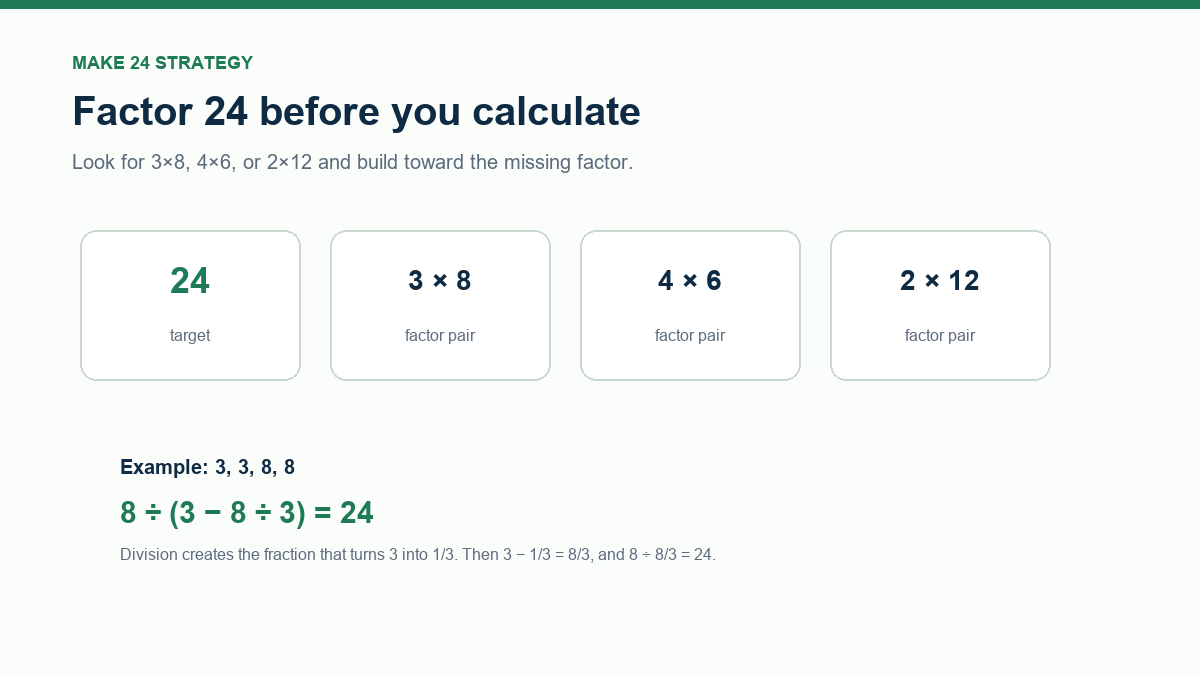
- Factor pairs are the fastest plan. Aim for 3×8, 4×6, or 2×12.
- Parentheses change everything. a+b×c is not the same as (a+b)×c.
- Division creates useful fractions. A fraction can turn an awkward number into the factor you need.
- Work backward from 24. Ask what two values could multiply, add, or divide to 24.
The rules in one place
You are given four numbers. Use each number exactly once. You may use the four basic operations — addition, subtraction, multiplication, and division — and parentheses. The result must be exactly 24. Concatenating digits is not allowed in the standard game, and you cannot introduce a new number.
The order of the numbers does not have to match the order they were given. Parentheses let you change the order of operations, which is why the same four numbers can have several valid solutions.
Start with the factors of 24
The most useful fact is that 24 has small factors: 1×24, 2×12, 3×8, and 4×6. If you can build one of those pairs from the four numbers, the rest of the puzzle often falls into place.
For example, if the numbers are 3, 4, 2, and 6, you might see 4×6 = 24 immediately. But you still have 3 and 2 left, and every number must be used. You need to incorporate them without changing the value: multiply by (3−2) or add (3−3), but you cannot reuse 3. A common trick is to build a factor of 1 from the remaining numbers, such as (3−2), then multiply 4×6×1 = 24. The full expression is 4×6×(3−2).
Work backward from 24
Instead of trying operations at random, ask what the last operation could be. The final step might be:
- Multiplication: something × something = 24, so look for 3×8, 4×6, or 2×12.
- Addition: something + something = 24, so look for a pair that sums to 24.
- Subtraction: something − something = 24, so the first value must be 24 larger than the second.
- Division: something ÷ something = 24, so the first value must be 24 times the second.
This backward approach narrows the search. It is especially useful when the four numbers are large or when a direct multiplication is not available.
The 3, 3, 8, 8 example
The classic difficult set is 3, 3, 8, 8. There is no way to make 24 with simple multiplication because the obvious 3×8 uses only two numbers. The solution uses division to create a fraction:
8 ÷ (3 − 8 ÷ 3) = 24
Why does this work? First, 8 ÷ 3 = 8/3. Then 3 − 8/3 = 9/3 − 8/3 = 1/3. Finally, 8 ÷ 1/3 = 8 × 3 = 24. The expression uses both 3s and both 8s exactly once. This is a good reminder that division is not a last resort; it is often the move that makes the puzzle possible.
Use parentheses deliberately
Without parentheses, multiplication and division bind more tightly than addition and subtraction. That standard order may not produce the result you want. Parentheses let you force a sum or difference to happen first.
Compare:
- 3 + 3 × 8 = 27
- (3 + 3) × 8 = 48
- 3 × (8 − 3) = 15
- 8 ÷ (3 − 8 ÷ 3) = 24
When an expression seems close but not exact, try moving the parentheses before changing the numbers. The structure is often the problem, not the arithmetic.
A practical solving routine
- Scan for an obvious factor pair: 3×8, 4×6, 2×12.
- If one pair is available, use the other two numbers to build 1, 2, or the missing factor.
- If no pair is available, try the largest number times something close to 24, then adjust with the remaining numbers.
- Try division: a fraction can turn a large number into a small factor.
- Check that every number appears exactly once and that the parentheses match.
- If you are stuck, use the Hint button to see one solution, then rebuild it yourself.
Make 24 in 2026: daily cards and speed variants
The 24 game has become a short-form arithmetic habit: four numbers, four operations, one target. The modern upgrade is the mode ladder. Calccc Make 24 now includes Easy, Classic, Daily, and Speed. The daily cards give everyone the same starting point; Speed adds a clock for players who already know the fraction and grouping tricks.
If you are learning, use Easy and write every expression. Move to Daily when you can find one solution in under a minute. Use Speed only after the basic patterns are automatic, not as a substitute for understanding.
Common mistakes
Using a number twice. The four cards are a budget, not a suggestion. Forgetting a number. A correct-looking expression that ignores one card is not a solution. Assuming left-to-right arithmetic. Multiplication and division happen before addition and subtraction unless parentheses say otherwise. Giving up on fractions. The 3, 3, 8, 8 puzzle is impossible without a fractional intermediate value. Not checking the final value. A near miss is still a miss.
Frequently asked questions
Can I use each number more than once in the 24 Game?
No. Each of the four numbers must be used exactly once. You may reorder them and use parentheses, but you cannot repeat or omit a number.
What are the best factor pairs for making 24?
The most useful pairs are 3×8, 4×6, and 2×12. Also remember 1×24, because a remaining expression can often be turned into 1.
How do you solve 3, 3, 8, 8?
Use 8 ÷ (3 − 8 ÷ 3) = 24. The intermediate value 8/3 creates the fraction 1/3, and 8 divided by 1/3 is 24.
Is the 24 Game only for numbers 1 to 13?
Many versions use cards from 1 to 13, but the rules work with other positive integers too. The Calccc version has Easy 1–9, Classic 1–13, Daily, and Speed modes.
Further reading