


Key takeaways
- A bulb lights its row and column. The light stops at black walls.
- No two bulbs may see each other. If two bulbs share a clear row or column, the board is invalid.
- 0 and 4 walls are free clues. A 0 wall forces all adjacent white squares to be empty; a 4 wall forces bulbs on all four sides.
- Every white square must be lit. A bulb can light itself and every visible square in its row and column.
- Numbered walls constrain their neighbours. Count how many bulbs touch the wall; it must match exactly.
The rules of Light Up
Light Up is played on a grid with white squares and black walls. Some black walls contain a number. You place bulbs on white squares. A bulb illuminates its own square and every square in the same row or column until a black wall blocks the line of sight. Diagonals do not matter.
To solve the puzzle:
- Every white square must be lit.
- No bulb may be lit by another bulb.
- Every numbered black wall must have exactly that many bulbs in the four squares directly above, below, left, and right.
- Unnumbered black walls have no count constraint.
These rules come from the classic Akari puzzle. The Simon Tatham collection describes the same conditions in its Light Up manual: all non-black squares lit, no light lit by another light, and numbered walls exactly satisfied.
Start with 0 and 4
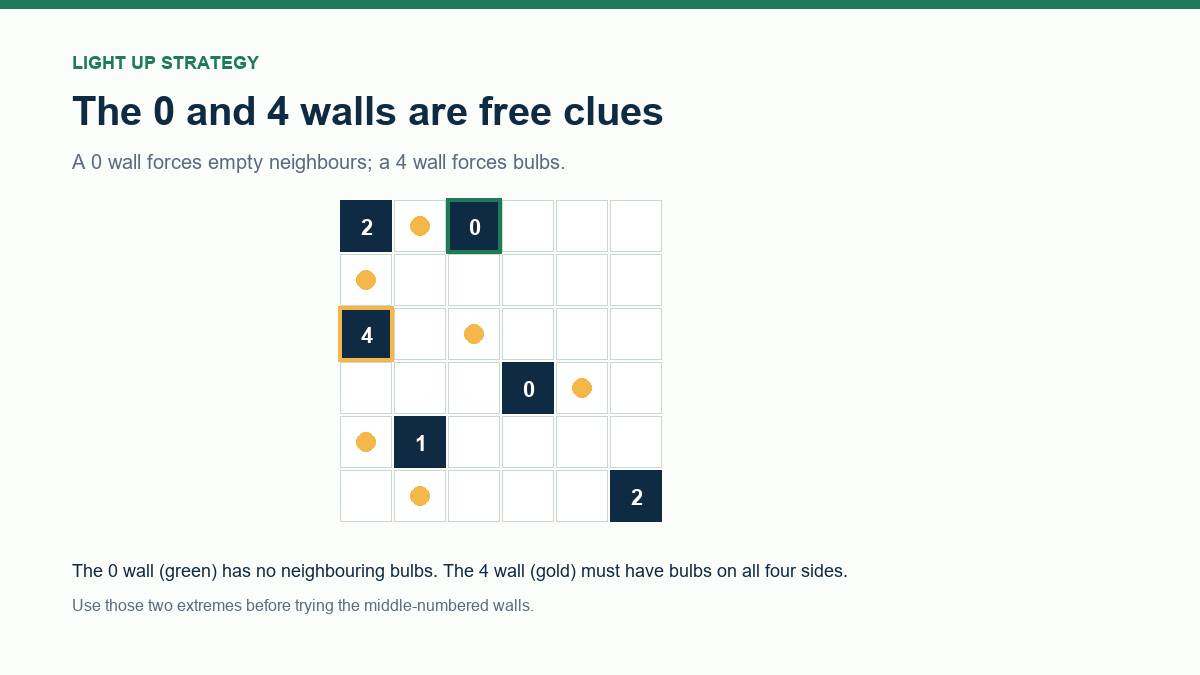
The fastest deductions come from the extremes. A wall numbered 0 cannot have any adjacent bulbs, so every white neighbour of that wall is empty. Mark those squares with X so you do not place a bulb there later.
A wall numbered 4 must have a bulb in all four orthogonal neighbours. Place all four bulbs immediately. This also means those bulbs cannot be placed anywhere else, and the squares they light cannot receive another bulb.
A wall numbered 1 is also useful. If a 1 wall has only one white neighbour, that neighbour must contain a bulb. If a 1 wall already touches one bulb, its other white neighbours are empty. A 2 or 3 works the same way: once the required number of adjacent bulbs is present, the remaining neighbours are empty.
Find squares that can only be lit from one direction
After the extreme walls, look at white squares near walls and edges. A square in a corner can only be lit from two directions. If one direction is blocked by a wall, the bulb must be in the other direction. A square at the end of a one-cell corridor may have only one possible lamp position.
For each unlit square, ask: which squares can see it? If there is only one candidate, place the bulb. If there are two candidates, keep them in mind and look for a wall number or another bulb that eliminates one.
Use wall counts as equations
A numbered wall is a small equation. If a 2 wall has two adjacent white squares and no bulbs, both must contain bulbs. If it has three adjacent white squares, exactly two of the three must be bulbs. That leaves three possibilities, which is not enough on its own, but another clue may eliminate one.
When a wall’s count is already satisfied, every other adjacent white square must be empty. This is the same “satisfied clue” logic used in Minesweeper and Kakuro. Mark those squares with X immediately.
A left-to-right solving order
A reliable method for 6×6 and 8×8 boards:
- Mark all forced empties around 0 walls.
- Place all forced bulbs around 4 walls.
- Check every 1 wall with only one available neighbour.
- Scan the top row for squares that can only be lit from below.
- Move to the next row and repeat.
- After each bulb, re-check the wall it touches and the row/column it lights.
This order prevents you from placing a bulb that looks useful but violates a wall count. It also keeps the board readable: you are always working from a constraint, not from intuition.
Light Up in 2026: daily Akari and variant thinking
Light Up, also called Akari, is a natural daily puzzle: small board, simple rules, and a satisfying complete state. Calccc Light Up includes Mini, Classic, and Daily modes. The daily board is a good place to practise the numbered-wall deductions without the pressure of a large grid. Variant thinking matters here: a wall labelled 0 and a wall labelled 4 force very different local patterns.
Start with 0 and 4 walls, then use the remaining line-of-sight constraints. On the daily board, do not place a bulb until you can name the wall or the row that forces it.
Common mistakes
Placing two bulbs in the same line. Even if a wall count is satisfied, two bulbs that see each other make the board invalid. Ignoring unlit squares. A board can have every wall satisfied and still leave a white square in darkness. Placing a bulb on a marked square. X marks mean “no bulb here”; respect them. Forgetting that walls block light. A bulb does not light through a black wall, so a square behind a wall needs its own light source. Treating a 0 wall as optional. A 0 wall is a hard constraint, not a hint.
Frequently asked questions
What is the 0 wall rule in Light Up?
A wall numbered 0 cannot have any bulbs in the four adjacent squares. Every white neighbour of a 0 wall must be empty, so mark them with X.
What is the 4 wall rule in Light Up?
A wall numbered 4 must have bulbs in all four orthogonal neighbours: above, below, left, and right. Place all four immediately, then check that no two of those bulbs see each other.
Can two bulbs see each other in Light Up?
No. If two bulbs are in the same row or column with no black wall between them, they light each other, which is invalid. The puzzle requires every bulb to be unlit by every other bulb.
Do all white squares need to be lit?
Yes. Every non-black square must be illuminated, including squares that do not contain a bulb. A bulb lights its own square and all visible squares in its row and column.
Further reading