


Key takeaways
- Two constraint types. Every row and column uses each digit once, and every sign must hold.
- Signs are local. A > sign eliminates one digit from each side immediately.
- Chains are stronger. A > B > C forces three different values in order.
- Extremes are useful. The smallest and largest digits are the easiest to place.
- No guessing needed on small boards. The 5×5 Mini is a good place to learn the loop.
The rules
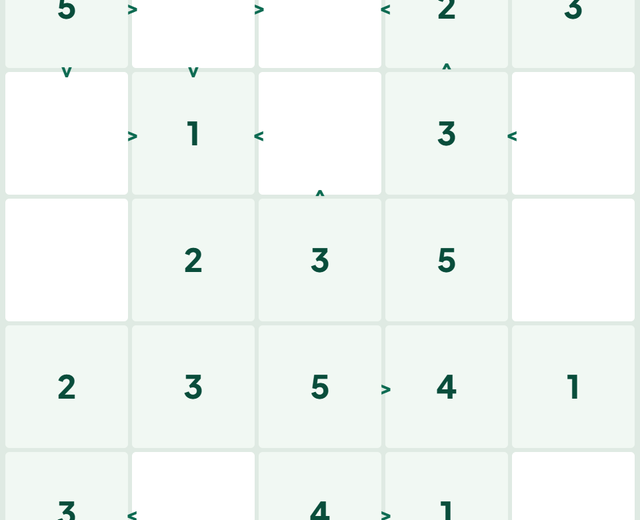
Fill the grid with 1 through N, where N is the grid size. Each row and column must contain every digit exactly once. The inequality signs between adjacent cells must be true: the open side faces the larger value. Some cells start with givens. Unlike sudoku, there are no boxes; the signs provide the extra structure.
Start with the extremes
A cell with a > sign pointing away from it cannot be the largest digit, because it must be greater than its neighbor. A cell with a < sign pointing toward it cannot be the smallest digit. Mark those exclusions first. On a 5×5 board, the digits are 1–5, so a cell that must be greater than two neighbors has a very small candidate set.
Read chains
If A > B > C, the three cells must be three different values in decreasing order. The maximum for A is N, the minimum for C is 1. If the chain has four cells, the middle cells are squeezed. Chains are the Futoshiki equivalent of a naked pair: they constrain several cells at once and often force a digit without any row scan.
Rows and columns
After sign eliminations, scan each row for a digit with only one possible cell. Then scan columns. The Latin-square rule is the same as sudoku, minus boxes. If a row already contains 1, 3, and 5, the remaining cells must be 2 and 4; the signs then decide which is which. Alternating between signs and line scans is faster than staring at one cell.
When the board is stuck
Look for a cell with only two candidates and test the consequences on paper. If one branch immediately violates a sign or duplicates a digit, the other is correct. On larger 7×7 boards, this is still deduction, not guessing, as long as you can explain why the branch fails. Avoid placing a value and hoping; Futoshiki boards are small enough that a contradiction is usually nearby.
Daily Futoshiki
Daily Futoshiki uses a shared board, so the difficulty is comparable across players. The daily format is useful for learning because you can replay the same puzzle mentally the next day and compare your first move. The best first move is usually the most constrained sign, not the most empty row.
Notation that helps
Write candidates only for cells that are constrained by a sign. A cell in an open area with no adjacent sign is usually easier to solve from its row or column later. If you do write notes, keep them in ascending order; it makes chains easier to compare. When a sign eliminates a candidate, erase it immediately rather than leaving stale notes.
On 7×7 boards, look for a row with many givens and a strong sign. The row often solves before the signs elsewhere. If two cells in a row have the same two candidates and one is constrained by a sign, the sign may resolve the pair. This is the Futoshiki equivalent of a naked pair, with inequality as the tiebreaker.
Use the daily board as a benchmark
Solve the Daily without notes, then solve it again with notes. Compare where the notes helped and where they slowed you down. The difference tells you which constraint type you are still learning.
A sign at the edge of the board has only one neighbor, so it eliminates a digit from one cell. Start at the edges before moving to the centre.
On the 7×7 board, write the digits 1–7 once in a corner as a reminder. The largest and smallest values do most of the early work.
Common mistakes
Reading the sign backward. The open mouth faces the larger value. Ignoring a chain. A single sign is local; a chain is a sequence. Filling a row before checking columns. Both must be valid. Forgetting givens. A given is a fixed constraint, not a suggestion.
Practice
Play Calccc Futoshiki Mini 5×5, then Classic 7×7 and Daily. Try to solve the Mini without notes; if you need a note, write only two candidates per cell.
Rules
Futoshiki is a Latin square with inequality signs between some cells. Each row and column contains the numbers 1 to n once. The signs tell you which neighbor is larger. Start with the most constrained cells and the signs that force a 1 or the maximum.
Solving
Mark candidates in each cell. A cell with a “greater than” sign on both sides is constrained. Chains of inequalities can eliminate candidates. If a row needs a 1 and one cell must be smaller than its neighbor, that cell is a candidate for 1. Use pencil marks and revisit.
Common mistakes
Reading the sign in the wrong direction; forgetting the Latin-square rule; and guessing before using the inequalities. Slow down at the end, when only a few candidates remain.
What to compare
Compare the completed grid with every row, column, and sign. A valid Latin square without the signs is not a solution.
Frequently asked questions
What is the difference between Futoshiki and Sudoku?
Futoshiki is a Latin square with inequality signs. It has no 3×3 boxes; the signs provide the extra constraints.
What is the best first move in Futoshiki?
Start with the strongest sign or chain, especially at the edge of the board. Then combine the sign exclusions with row and column uniqueness.
Further reading