


Key takeaways
- Interest is charged on the remaining balance, not the original amount, every month.
- A level payment does not mean a level split; the principal share rises over time.
- Extra payments go to principal and reduce future interest; the earlier the extra, the larger the effect.
- A longer term lowers the payment but usually increases total interest.
- Compare total paid and payoff date, not just the monthly payment.
The amortization formula
For a fixed-rate loan with monthly payments, the payment is:
M = P × r × (1 + r)n ÷ ((1 + r)n − 1)
where P is the principal, r is the monthly interest rate (annual rate ÷ 12 ÷ 100), and n is the number of monthly payments. The formula produces a level payment. The split inside that payment is not level.
Each month, interest = remaining balance × monthly rate. Principal = payment − interest. The new balance is the old balance minus principal. Repeat until the balance is zero.
A 30-year example
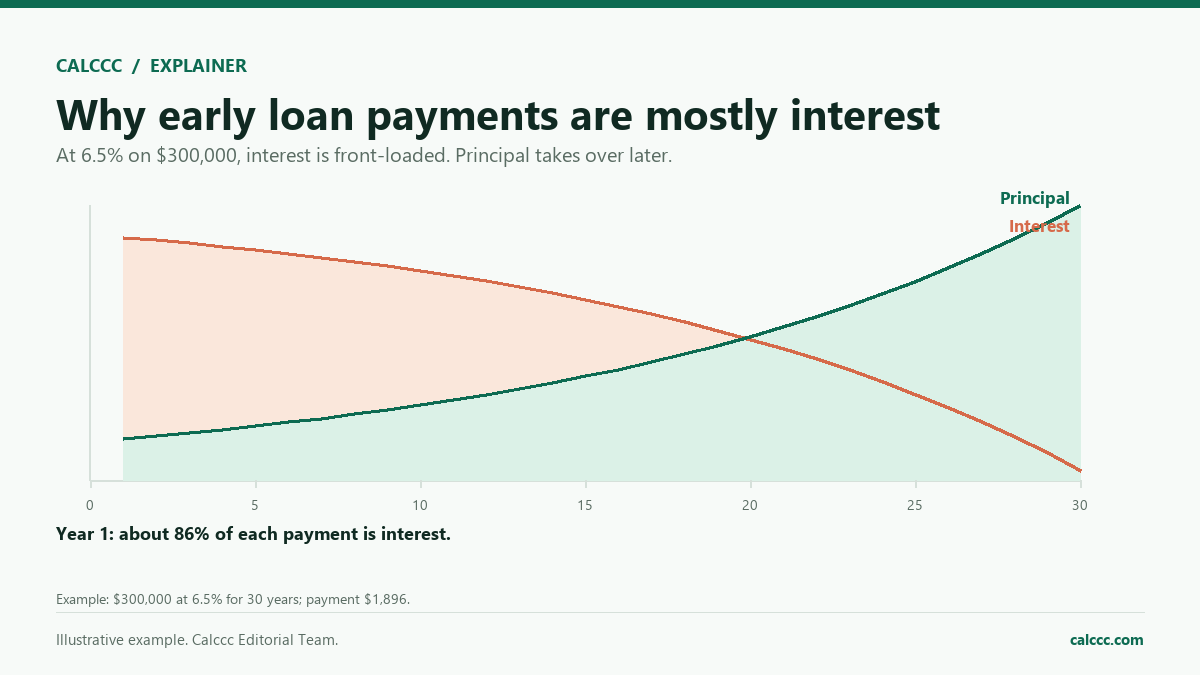
A $300,000 loan at 6.5% for 30 years has a monthly payment of about $1,896. In the first month, interest is $300,000 × 0.0054167 = $1,625. The remaining $271 goes to principal. By the final year, interest is a small fraction of the payment and most of it goes to principal.
Across the first 12 months, roughly 86% of the payments go to interest and 14% to principal. That is not a lender trick; it is the arithmetic of charging interest on a large balance.
Year-by-year view
| Loan year | Interest paid that year | Principal paid that year | Approximate balance at year end |
|---|---|---|---|
| 1 | $19,400 | $3,350 | $296,650 |
| 5 | $18,400 | $4,350 | $279,200 |
| 10 | $16,700 | $6,050 | $250,900 |
| 15 | $13,900 | $8,850 | $212,900 |
| 20 | $9,700 | $13,050 | $163,400 |
| 25 | $4,900 | $17,850 | $99,600 |
| 30 | $400 | $22,350 | $0 |
Figures are rounded and assume no extra payments, fees, or rate changes. The shape matters more than the exact dollars: interest is front-loaded.
What extra payments do
An extra payment is applied to principal (confirm with the servicer). Because future interest is charged on a smaller balance, the loan finishes sooner and costs less. A $100 extra payment every month on the example loan saves tens of thousands of dollars and shortens the term by several years; a single $5,000 payment in year one has a different effect than the same $5,000 spread over five years.
The earlier the extra payment, the more future interest it prevents. That is why a one-time payment at the start can outperform a larger payment later. Always confirm that the servicer applies extras to principal and does not treat them as prepaid regular payments.
Term length: the trade-off
| Term | Monthly P&I on $300,000 at 6.5% | Total interest |
|---|---|---|
| 15 years | $2,613 | $170,300 |
| 20 years | $2,237 | $236,900 |
| 30 years | $1,896 | $382,600 |
A shorter term raises the required payment but cuts total interest. A longer term lowers the payment but keeps the balance outstanding longer. Neither is universally right; the answer depends on cash flow, stability, and what else you would do with the difference.
2026 calculator update: what changed
The linked calculator has been upgraded. It now includes a professional worksheet with the inputs used, the method and scope, and a one-variable sensitivity check for finance tools. You can save two input sets as Scenarios A/B and compare the results side by side. The Print / PDF action produces a branded worksheet, and table-producing calculators can export a CSV.
The page also explains why a bank, lender, broker, or provider can quote a different number: rate versus APR, fees, credit pricing, taxes, insurance, and timing. Use the written quote or Loan Estimate as the binding document, not the calculator estimate.
Schedule and extra payments
Each payment is interest on the remaining balance plus principal. Early payments are mostly interest; later payments are mostly principal. Extra principal reduces the balance immediately and saves future interest. Tell the servicer to apply it to principal.
What to compare
Compare the required payment, total interest, and payoff date. A longer term lowers the payment and raises total interest.
Frequently asked questions
Why is my first payment almost all interest?
Because interest is calculated on the outstanding balance. At the start, the balance is the full loan amount, so the interest charge is largest. As principal is repaid, the interest charge falls.
Do extra payments always reduce interest?
Usually, if they are applied to principal and there is no prepayment penalty. Confirm with the servicer; some systems apply extra funds to the next scheduled payment instead.
Is a lower monthly payment always better?
No. A longer term can lower the payment while increasing total interest. Compare the total cost and the payoff date.
How does an adjustable rate change this?
An adjustable-rate loan recalculates the payment when the rate changes. The amortization shape remains similar, but the payment and total interest are not fixed.
How we checked this guide
We calculated the payment and yearly split directly from the standard amortization formula and cross-checked the first-month interest by hand. The CFPB’s Loan Estimate explainer describes how lenders disclose the payment and total interest; the calculator follows the same fixed-rate assumptions. The table values are rounded for readability.
Further reading
Keep exploring
Decision path