


Key takeaways
- Confirm whether your loan is federal or private; the rules differ.
- Extra payments usually save interest and shorten the term.
- If you are pursuing PSLF or forgiveness, extra payments may not help.
- Ask the servicer to apply extra money to a specific loan, not just the account.
- Keep an emergency fund before sending every spare dollar to the loan.
Federal vs. private student loans
Federal student loans have income-driven repayment plans, forgiveness programs, and servicer rules set by the Department of Education. Private student loans are contracts with a bank or lender; they may have fewer hardship options and different prepayment rules.
Before making extra payments, identify the loan type and servicer. Federal loans are managed through StudentAid.gov and the loan servicer. Private loans require reading the promissory note or contacting the lender.
The simple math
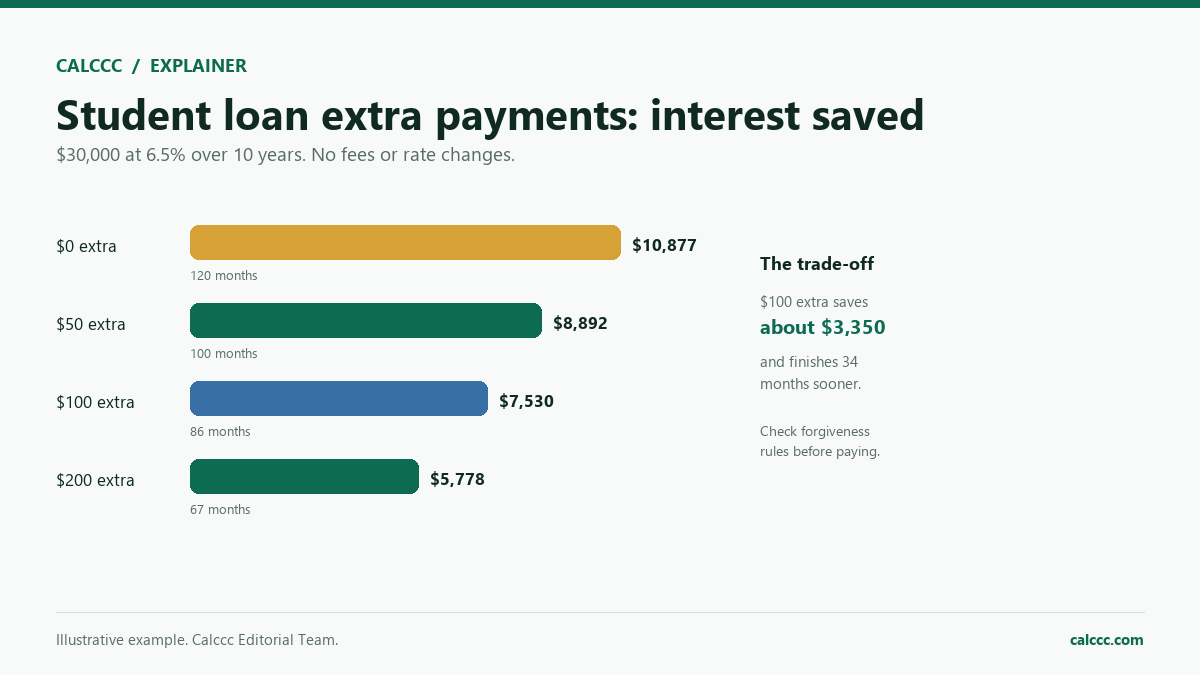
Example: $30,000 at 6.5% over 10 years. The standard payment is about $341. Extra payments go to principal and reduce the interest charged next month.
| Extra per month | Payoff time | Total interest | Interest saved |
|---|---|---|---|
| $0 | 120 months | $10,877 | — |
| $50 | 100 months | $8,892 | $1,985 |
| $100 | 86 months | $7,530 | $3,347 |
| $200 | 67 months | $5,778 | $5,099 |
The numbers assume a fixed rate, no fees, and on-time payments. They are illustrative; your servicer’s application rules can change the result.
When extra payments may not help
Public Service Loan Forgiveness (PSLF)
PSLF forgives the remaining balance after 120 qualifying payments while working for a qualifying employer. If you are on track, paying extra can reduce the amount forgiven. The better move may be to keep payments at the required amount and document qualifying employment.
Income-driven repayment with forgiveness
Some income-driven plans forgive a remaining balance after a set number of years. Extra payments can reduce the balance and the amount forgiven. Whether that is good depends on your plan, tax treatment, and timeline.
Very low interest and a long horizon
If the rate is low and you have higher-interest debt or an employer match, the extra dollar may do more elsewhere. This is a comparison, not a rule.
How to make extra payments correctly
- Log in to the servicer’s portal and find the extra-payment option.
- Choose the loan you want to target, especially if you have multiple loans.
- Confirm the payment is marked “principal” or “do not advance due date.”
- Check the next statement to verify the balance and due date.
- Keep records of every extra payment.
Should you refinance instead?
Refinancing a federal loan to a private loan can lower the rate but gives up federal protections and forgiveness eligibility. Do not refinance federal loans without understanding what you are giving up. For private loans, refinancing can be a legitimate way to lower the rate; compare the new term and fees.
How interest accrues between payments
Most student loans accrue interest daily. That means the balance grows a little every day, even if you make one payment a month. When you send an extra payment, ask when it is applied. A payment posted immediately after the due date may reduce less interest than one posted earlier in the cycle. The difference is usually small, but over several years it adds up.
Keep the regular payment on time. Extra money is optional; a missed required payment is not. If you can only do one thing, automate the required payment first, then add the extra amount when your budget allows.
2026 calculator update: what changed
The linked calculator has been upgraded. It now includes a professional worksheet with the inputs used, the method and scope, and a one-variable sensitivity check for finance tools. You can save two input sets as Scenarios A/B and compare the results side by side. The Print / PDF action produces a branded worksheet, and table-producing calculators can export a CSV.
The page also explains why a bank, lender, broker, or provider can quote a different number: rate versus APR, fees, credit pricing, taxes, insurance, and timing. Use the written quote or Loan Estimate as the binding document, not the calculator estimate.
Extra payments
Extra payments reduce the balance and future interest. Tell the servicer to apply the extra amount to principal, not to the next payment. Check whether the loan has a prepayment penalty. For federal loans, forgiveness and income-driven plans can change the best strategy.
What to compare
Compare the interest saved, the payoff date, and the forgiveness eligibility. Extra payments can reduce forgiveness if the balance is forgiven after a set period.
Frequently asked questions
Do extra payments always reduce interest?
Usually, if they are applied to principal and there is no prepayment penalty. If the servicer treats them as early regular payments, the benefit is delayed.
Can I target one loan?
Federal servicers may let you specify a loan or apply extra to the highest-rate loan. Ask before paying. Private lenders vary.
Does paying extra hurt forgiveness?
It can reduce the amount forgiven under PSLF or income-driven plans. Check your plan before making extra payments.
Should I pay extra or invest?
Compare the loan rate with the expected after-tax return and your risk tolerance. Also keep an emergency fund; liquidity matters.
How we checked this guide
We ran the example through the student loan calculator with a fixed rate and no fees, then compared interest and payoff month. Federal forgiveness and repayment rules were checked against StudentAid.gov and CFPB student-loan resources. This is not individualized advice.
Further reading
Keep exploring
Decision path