What this calculator does
This student loan calculator estimates the monthly payment on a fixed-rate loan and the interest you will pay over the full term. It works for federal Direct Loans and for many private loans on a standard schedule. Use it to compare a 10-year term with a 20-year term, to see what a lower rate saves, or to check a refinanced loan before you sign.
Is this the right calculator?
Use it when
- You are estimating a fixed-rate student loan payment and total interest.
- You want to compare a standard repayment plan with a shorter or longer term.
Use something else when
- You need income-driven repayment, forgiveness, or deferment rules.
- You need federal loan servicer-specific fees or subsidized-interest timing.
What changes the result most
| Interest rate | A higher rate raises the payment and total interest. |
|---|---|
| Repayment term | A longer term lowers the payment but increases total interest. |
| Amount borrowed | The principal drives both the payment and the interest cost. |
How to use it
- Enter loan amount, rate, and term.
- Open Advanced options to add origination fees, extra payments, or a start date.
- Review the monthly payment, total interest, total paid, and payoff date.
- Check the yearly schedule.
- Change one assumption at a time to compare terms and extra payments.
How it works
Example calculations
Example 1: $30,000 at 6.5% for 10 years
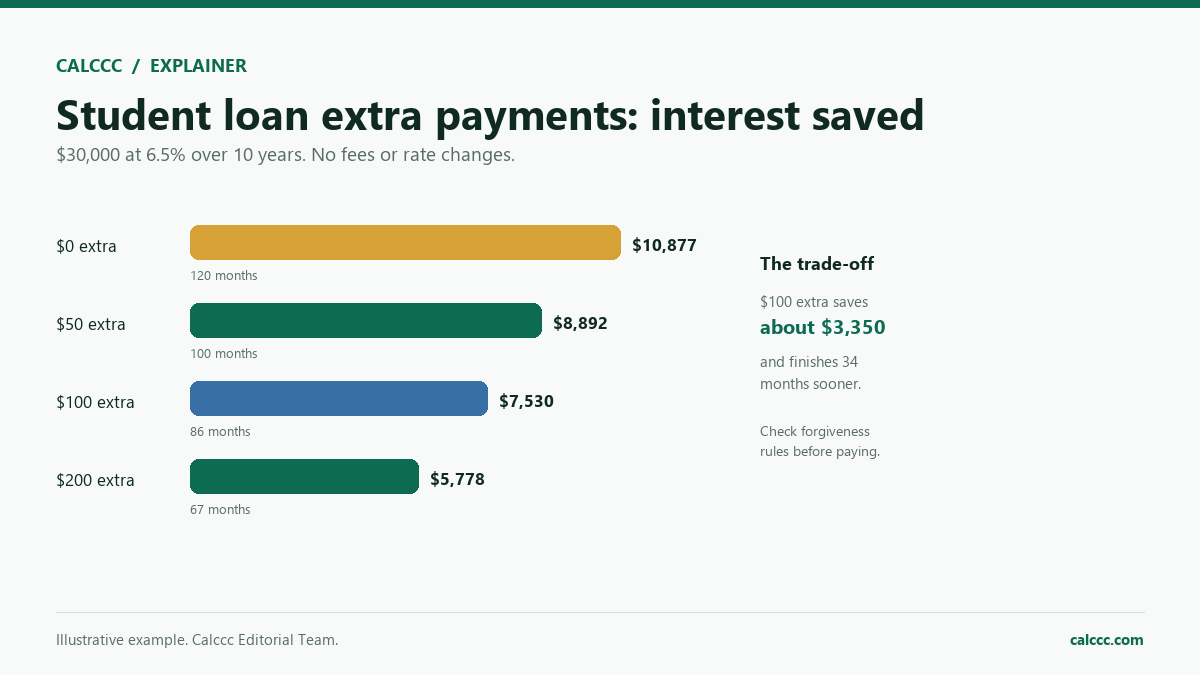
The monthly payment is about $340.64. Over 120 payments you repay about $40,877, of which about $10,877 is interest. That is roughly 36 cents of interest for every dollar borrowed.
Example 2: $20,000 at 5% for 10 years
The monthly payment is about $212.13. Total paid is about $25,456 and total interest is about $5,456. The lower rate cuts the interest per dollar borrowed by about a quarter.
Example 3: $50,000 at 7% for 20 years
The monthly payment is about $387.65. Total paid is about $93,036, with about $43,036 of interest. The longer term lowers the payment by about a third but more than doubles the interest of a 10-year loan at the same rate.
What the result means
The term drives both numbers. A longer term lowers the required payment, which can make a budget work, but it raises total interest because the balance stays outstanding longer. The rate matters just as much. On a $30,000 10-year loan, dropping the APR from 6.5% to 5% saves about $2,700 over the term. Federal loans also offer repayment plans this calculator does not model, including income-driven repayment, graduated plans, and forgiveness programs, and those can change both the monthly figure and the total. Private refinancing may lower the rate but usually gives up federal protections such as deferment and income-driven options. Treat the result as the cost of a standard fixed-rate schedule.
Common mistakes
- Entering the original amount after part of the loan is repaid.
- Comparing terms by monthly payment only, not total interest.
- Assuming the APR already includes the origination fee.
- Modeling a standard plan for a loan on income-driven repayment.
- Refinancing federal loans without checking which protections are lost.
Assumptions and limits
- The interest rate is fixed for the whole term.
- Payments are equal and monthly, starting one month after repayment begins.
- The full loan amount is disbursed and no interest accrues before repayment.
- Origination fees, late fees, and insurance are excluded.
- Deferment, forbearance, forgiveness, and extra payments are not modeled.
Frequently asked questions
Does this include federal repayment plans?
No. It models a fixed-rate, equal-payment loan. Income-driven repayment, deferment, and forgiveness are separate.
How do extra payments help?
Extra principal reduces the balance and future interest. The calculator shows interest saved and months saved.
Are origination fees included?
You can add them to total cost; they are not financed in this estimate.
Can I use this for a refinance?
Yes, enter the new loan amount, rate, term, and fees. Compare total cost, not just the payment.
Why is my payment different?
Servicer fees, capitalization, repayment plans, and rounding can change the amount.
Can I see a monthly schedule?
The page shows a yearly summary; the same formula can generate monthly rows.
Sources
2026 update
How to use the professional output
This page is not just a formula box. The result is designed to be checked, compared, and taken away.
- Professional worksheet. The result includes the inputs used, the method and scope, and a one-variable sensitivity check for finance calculators.
- A/B scenarios. Save two input sets in the browser and compare the primary, secondary, and breakdown figures side by side.
- Print / PDF and CSV. Print a branded worksheet, or export the year-by-year table when the calculator produces one.
- Quote differences. The section below explains why a bank, lender, broker, or provider can quote a different number.
The formulas and assumptions above still govern the number. The worksheet makes the estimate auditable; it does not make it a lender quote, tax return, or personalized advice.
Before you use a quote
Why your bank, lender, or provider’s number may differ
A lender’s quote can differ from this estimate because the advertised rate is not always the APR, and fees and credit pricing are lender-specific.
What changes the quote
- APR versus interest rate. Origination, documentation, and registration fees are part of the APR but not the note rate.
- Credit and term. A longer term lowers the payment but usually raises total interest.
- Taxes and insurance. Sales tax, registration, and required coverage vary by state and lender.
- Promotional pricing. Dealer or issuer incentives may be conditional and can change the effective cost.
How to compare offers
- Compare the APR and total cost, not only the monthly payment.
- Ask for a written quote or Loan Estimate with all fees itemized.
- Use the same loan amount, term, date, and assumptions for every offer.
- Check what is excluded: taxes, insurance, closing costs, maintenance, or provider fees.
- Keep an emergency reserve; the lowest payment is not always the safest choice.
Reference: CFPB Loan Estimate explainer.
Part of a decision center
Loan Center
See the companion tools, decision guides, and patterns that go with this calculator.
Go deeper