


Key takeaways
- Every tree has one tent. Every tent belongs to one tree.
- Counts are exact. A row marked 0 has no tents at all.
- No touching tents. The diagonal rule eliminates many cells.
- Grass is information. Mark impossible cells so you do not revisit them.
- Start constrained. A tree with one adjacent free cell is a free placement.
The rules in one place
The board contains trees. You place tents in empty cells. Each tree is paired with exactly one orthogonally adjacent tent, each tent is paired with exactly one tree, and no two tents touch horizontally, vertically, or diagonally. The numbers at the ends of each row and column give the exact number of tents in that line.
Start with the counts
A row or column with a count of 0 can be marked as grass immediately. A line whose count equals its number of available cells must be entirely tents, subject to the no-touch rule. Most puzzles open with a mix of small counts and a few forced trees. Do not start by guessing a tree’s partner; start by finding the tree that has only one legal neighbor.
Pairing logic
For each tree, list its orthogonal neighbors that are not trees, not adjacent to an existing tent, and not grass. If only one remains, that cell is a tent. Once placed, mark all eight neighbors of the tent as grass, excluding trees, and reduce the row and column counts. The board shrinks quickly after the first few forced pairs.
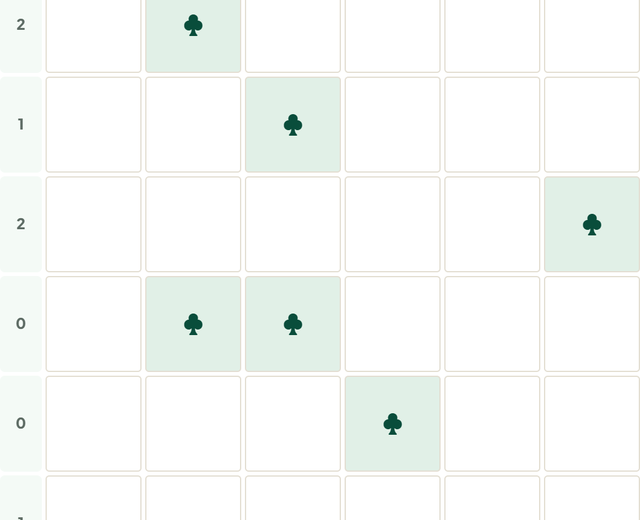
When a tree has two options
If a tree has two possible tent cells, do not choose yet. Look at the row and column counts. If both options are in the same row, that row must contain one tent from this tree; if the row count is already met, both options are impossible. If the two options are in different rows, the tree’s tent contributes to one of those rows but not both. Use the counts to rule out one branch before placing.
The no-touch rule
The diagonal restriction is stronger than it looks. A tent in the corner of a 2×2 block eliminates the other three cells for tents. When you place a tent, mark the surrounding eight cells as grass. This is not optional bookkeeping; it is the main source of deductions. A puzzle that looks stuck often opens after a single grass mark.
Daily Tents
Daily Tents uses a seeded board, so every player gets the same tree layout and counts. The daily format is good for practising the matching loop without random difficulty swings. If you use the Hint, note which deduction it revealed: a forced tree, a count closure, or a no-touch elimination. That tells you which rule to look for next time.
Use a two-pass scan
First pass: place every tent that is forced by a tree with one legal neighbor, and mark the surrounding grass. Second pass: use the row and column counts to close lines and find trees with two options. Do not mix the passes. The first pass shrinks the board; the second pass uses the smaller board to find deductions that were invisible before. This is faster than staring at an unmarked grid.
When two trees compete for the same tent cell, the cell cannot belong to both. If one tree has another option and the other does not, the shared cell belongs to the constrained tree. That is a matching argument, not a guess. Practise it on Mini boards before moving to 8×8.
Check the totals
Add the row clues and the column clues; both totals must equal the number of trees. If they do not, the puzzle is inconsistent. If they do, use the total as a sanity check before placing the last few tents.
When a row count is met, every other cell in that row is grass. Mark them immediately; the rule is exact, not a suggestion.
Common mistakes
Matching a tree to the nearest tent. Proximity is not a rule; adjacency and counts are. Forgetting diagonals. Two tents can be diagonally adjacent and still invalid. Ignoring zero counts. A zero row is a free set of grass marks. Placing a tent before checking the count. A legal adjacency can still break a row total.
Practice
Play Calccc Tents Mini 6×6 first, then the 8×8 Classic and Daily boards. Aim to place every tent with a stated reason: count, forced neighbor, or no-touch elimination.
Rule check
Every tree has exactly one tent, and every tent is attached to a tree horizontally or vertically. Tents never touch each other, even diagonally. The row and column counts tell you how many tents belong in each line. Start with rows or columns that are 0 or equal to the line length; those are the most constrained.
Solving order
Mark trees with only one possible tent first. A tree at a corner or against a wall has fewer neighbors. Once a tent is placed, cross out the surrounding cells and reduce the row/column counts. A row with count 0 can be cleared entirely. A row whose remaining cells equal its remaining count must be all tents.
Common mistakes
Placing two tents that touch diagonally; forgetting that a tent can attach to only one tree; and treating a tree as satisfied before checking the count. Slow down at the end, when the remaining cells are tightly constrained.
What to compare
Compare the row and column counts after every placement. If the counts do not match, the board is wrong even if the tents look plausible.
Frequently asked questions
Can two tents touch in Tents?
No. Tents cannot touch horizontally, vertically, or diagonally. The no-touch rule is one of the main sources of deductions.
Does every tree have exactly one tent?
Yes. Every tree is paired with exactly one orthogonally adjacent tent, and every tent belongs to exactly one tree.
Further reading