What this calculator does
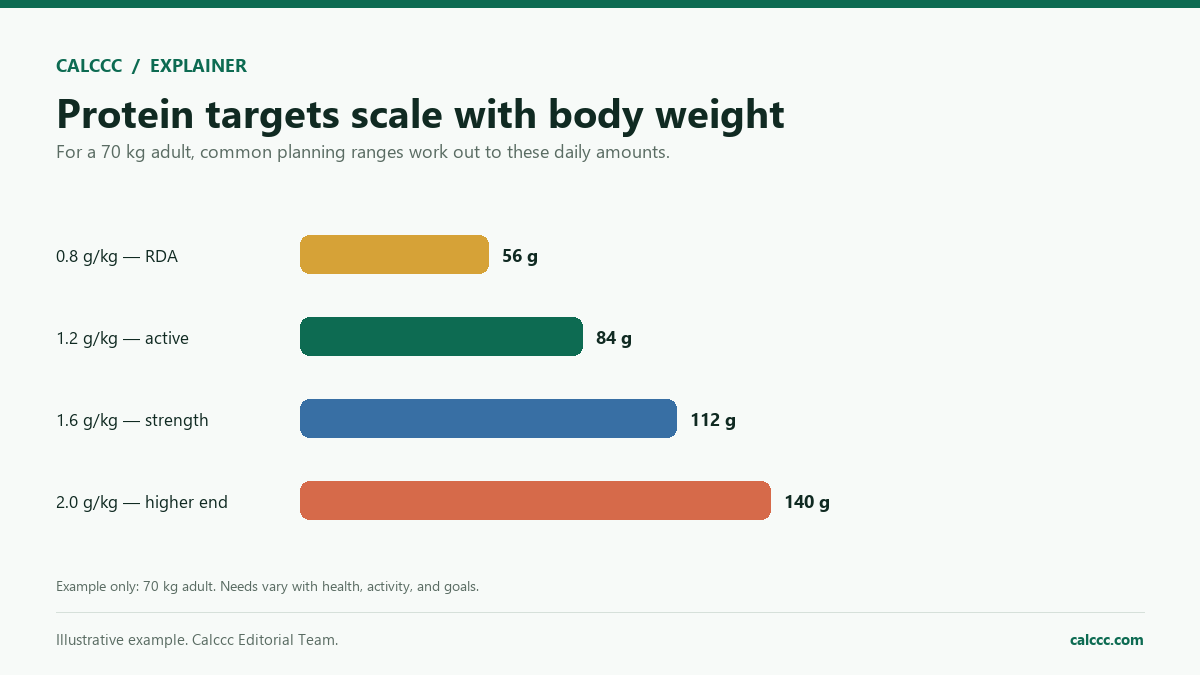
Protein needs scale with body weight and activity. Sedentary adults need less than people training hard, and people trying to preserve muscle while losing fat often land at the higher end. This calculator uses common general ranges: 0.8 g/kg for sedentary, 1.0 for light activity, 1.2 for moderate, 1.4 for active, and 1.6 for athletes. Those are planning numbers, not medical targets.
How to use it
- Choose pounds or kilograms and enter your body weight.
- Pick the activity level closest to your normal week.
- Read the daily protein target.
- Use the per-meal figure to spread protein across three meals.
- Adjust with a dietitian if you have a clinical condition.
How it works
Example calculations
Example 1: 165 lb, moderate activity
165 lb is about 74.8 kg. At 1.2 g/kg, the target is 90 g per day, about 30–33 g per meal, and 359 kcal from protein.
Example 2: 200 lb, active
200 lb is about 90.7 kg. At 1.4 g/kg, the target is 127 g per day, about 42–47 g per meal, and 508 kcal from protein.
Example 3: 140 lb, light activity
140 lb is about 63.5 kg. At 1.0 g/kg, the target is 64 g per day, about 21–23 g per meal, and 254 kcal from protein.
What the result means
Protein is only one part of the diet. Total calories, food quality, fiber, and training determine whether the target helps. Very high protein intakes are not automatically better, and people with kidney disease may need a lower target. Spread protein across meals rather than eating it all at once, and treat the number as a starting point to adjust based on hunger, performance, and lab work.
Common mistakes
- Using body weight in pounds as if it were kilograms.
- Choosing athlete-level protein without the training load to match.
- Counting protein calories twice in a calorie target.
- Ignoring medical conditions that change protein needs.
- Assuming more protein always means more muscle.
Assumptions and limits
- The person is a healthy adult without kidney or liver disease.
- Activity level is a rough description of the normal week.
- Body weight is current and not adjusted for pregnancy.
- The target is a planning range, not a prescription.
- Protein calories are 4 kcal per gram.
Frequently asked questions
How much protein do I need per day?
A common general range is 0.8–1.6 g per kg of body weight, depending on activity. This calculator maps five activity levels to that range.
Is 1.6 g/kg enough for strength training?
It is a common upper planning range for many recreational lifters. Individual needs vary; a sports dietitian can tailor it.
Can I eat all my protein in one meal?
You can, but spreading it across meals is usually more practical and may support muscle protein synthesis better.
Does protein intake need to change with age?
Older adults often need more protein to preserve muscle, but clinical guidance should come from a clinician.
Is this safe with kidney disease?
No. People with kidney disease may need a restricted protein intake and should follow a clinician's target.
Should I count plant protein differently?
Plant proteins are included in the total. Keep an eye on the overall amino acid mix and total calories.
Sources
2026 update
How to use the professional output
This page is not just a formula box. The result is designed to be checked, compared, and taken away.
- Professional worksheet. The result includes the inputs used, the method and scope, and a one-variable sensitivity check for finance calculators.
- A/B scenarios. Save two input sets in the browser and compare the primary, secondary, and breakdown figures side by side.
- Print / PDF and CSV. Print a branded worksheet, or export the year-by-year table when the calculator produces one.
The formulas and assumptions above still govern the number. The worksheet makes the estimate auditable; it does not make it a lender quote, tax return, or personalized advice.
Part of a decision center
Health Decision Center
See the companion tools, decision guides, and patterns that go with this calculator.
Go deeper