What this calculator does
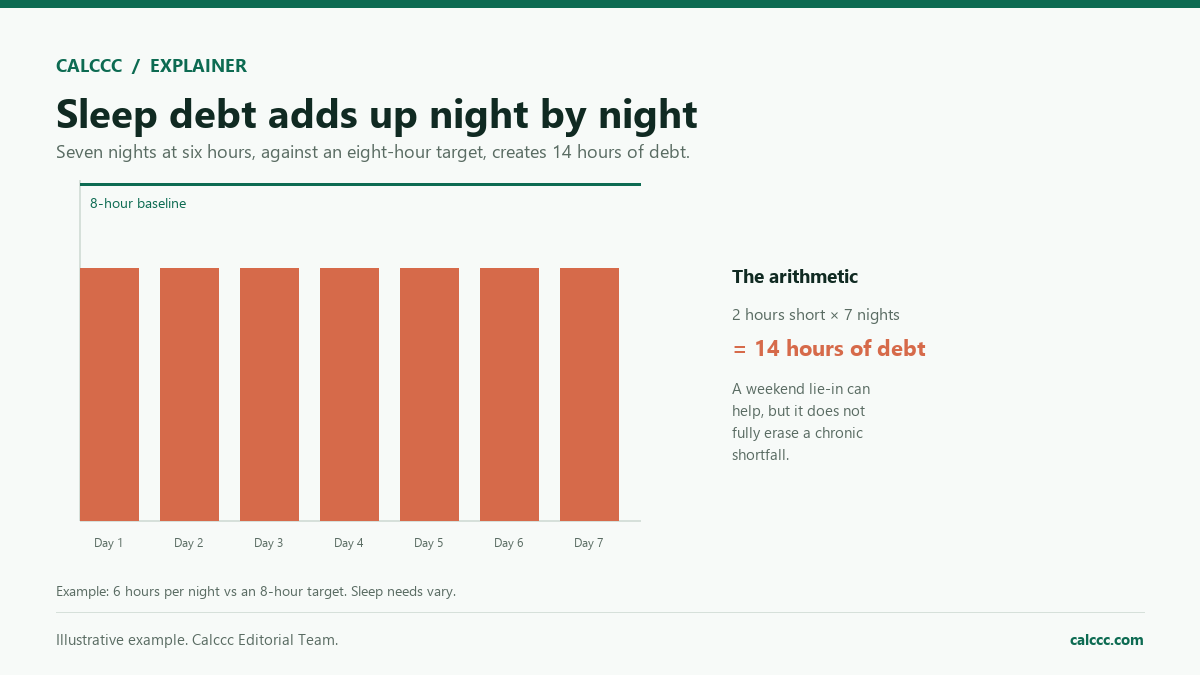
Sleep debt is the running total of sleep you wanted and sleep you got. This calculator turns a nightly shortfall into hours, then divides those hours across recovery nights so you can see how much extra sleep a catch-up plan would need. It assumes the shortfall is the same every night, which real weeks rarely are. Use it to plan a gentler stretch after a busy week, not to self-diagnose a sleep problem. Recovery sleep cannot fully undo every effect of lost sleep.
How to use it
- Enter the hours of sleep you aim for each night.
- Enter your average actual hours of sleep.
- Enter the number of nights in the period.
- Enter how many recovery nights you can plan.
- Review the debt, extra hours per recovery night, and totals.
How it works
Example calculations
Example 1: 8 target, 6.5 actual, 7 nights
The shortfall is 1.5 hours a night, so debt is 10.5 hours. Over 3 recovery nights, that is 3.5 extra hours. Actual sleep totals 45.5 hours against a 56-hour target.
Example 2: 7.5 target, 7 actual, 14 nights
The shortfall is 0.5 hours a night, so debt is 7 hours. Seven recovery nights need 1 extra hour each. Actual sleep totals 98 hours against 105.
Example 3: 8 target, 7 actual, 5 nights
The shortfall is 1 hour a night, so debt is 5 hours. Five recovery nights need 1 extra hour each. Actual sleep totals 35 hours against 40.
What the result means
The debt figure is arithmetic, not a clinical measure. It treats every lost hour as equal and every night as the same length, while real sleep varies and the body does not repay sleep hour for hour. A 10.5-hour debt does not mean one long weekend will fix everything. Spreading extra sleep across several nights is usually easier than a single marathon, and a consistent schedule supports the body clock. Recovery sleep can improve alertness, but it does not fully reverse the effects of a long stretch of short sleep. If you often sleep far less than your target, talk with a clinician.
Common mistakes
- Counting time in bed instead of time actually asleep.
- Averaging only the two or three worst nights.
- Planning all recovery sleep in one long night.
- Using the estimate to justify a repeat cycle of short sleep.
- Treating sleep debt as a diagnosis rather than a planning figure.
Assumptions and limits
- The target sleep length stays the same every night.
- Actual hours mean time asleep, not time in bed.
- Every night in the period has the same shortfall.
- Naps are not counted in the totals.
- Sleep debt is treated as linear and fully payable, which is a simplification.
Frequently asked questions
Can I catch up on sleep?
Partly. Extra sleep can improve alertness after a short stretch, but one long sleep does not fully reverse ongoing sleep loss. A steady schedule helps more than one recovery night.
How is sleep debt calculated?
Subtract your average actual sleep from your target, then multiply by the number of nights. Seven nights at 1.5 hours short is 10.5 hours of debt.
Is extra weekend sleep bad?
A little extra can help after a hard week, but a large shift in wake time can push the body clock later and make Monday harder.
Should naps count?
Naps do provide sleep, but this calculator does not include them. Count nap time separately, and keep naps short and early.
How long does recovery take?
It varies with how much sleep was lost, how long the shortfall lasted, and how well you sleep during recovery. Plan several nights of extra sleep.
When should I see a clinician?
Seek advice if you have trouble falling or staying asleep, loud snoring, pauses in breathing, or daytime sleepiness that persists despite enough time in bed.
Sources
2026 update
How to use the professional output
This page is not just a formula box. The result is designed to be checked, compared, and taken away.
- Professional worksheet. The result includes the inputs used, the method and scope, and a one-variable sensitivity check for finance calculators.
- A/B scenarios. Save two input sets in the browser and compare the primary, secondary, and breakdown figures side by side.
- Print / PDF and CSV. Print a branded worksheet, or export the year-by-year table when the calculator produces one.
The formulas and assumptions above still govern the number. The worksheet makes the estimate auditable; it does not make it a lender quote, tax return, or personalized advice.
Go deeper