


Key takeaways
- Island numbers are exact degrees. A 4 needs four bridge ends; a 1 needs one.
- Two bridges may run between the same pair. The maximum is two, not one.
- Bridges are horizontal or vertical only. Diagonal connections are not allowed.
- No crossings. A horizontal bridge and a vertical bridge cannot intersect.
- All islands must be connected. A set of nicely numbered islands that is split into two groups is not solved.
The rules of Hashi
Hashi is played on a grid of islands. Each island contains a number. You connect islands with bridges that run horizontally or vertically. The rules are:
- The number of bridges terminating at an island must equal the number written on it.
- At most two bridges may connect the same pair of islands.
- Bridges may not cross.
- All islands must be connected into a single network.
- Bridges cannot pass through other islands.
The Simon Tatham Bridges manual describes the same default rules and notes that the puzzle is usually credited to Nikoli. The Calccc implementation uses a generated island layout and checks the same constraints.
Think in degrees, not paths
Every bridge has two ends, so it contributes one to each island it touches. A single bridge between two islands raises each island’s count by one. A double bridge raises each by two. The number on an island is its degree in the final graph.
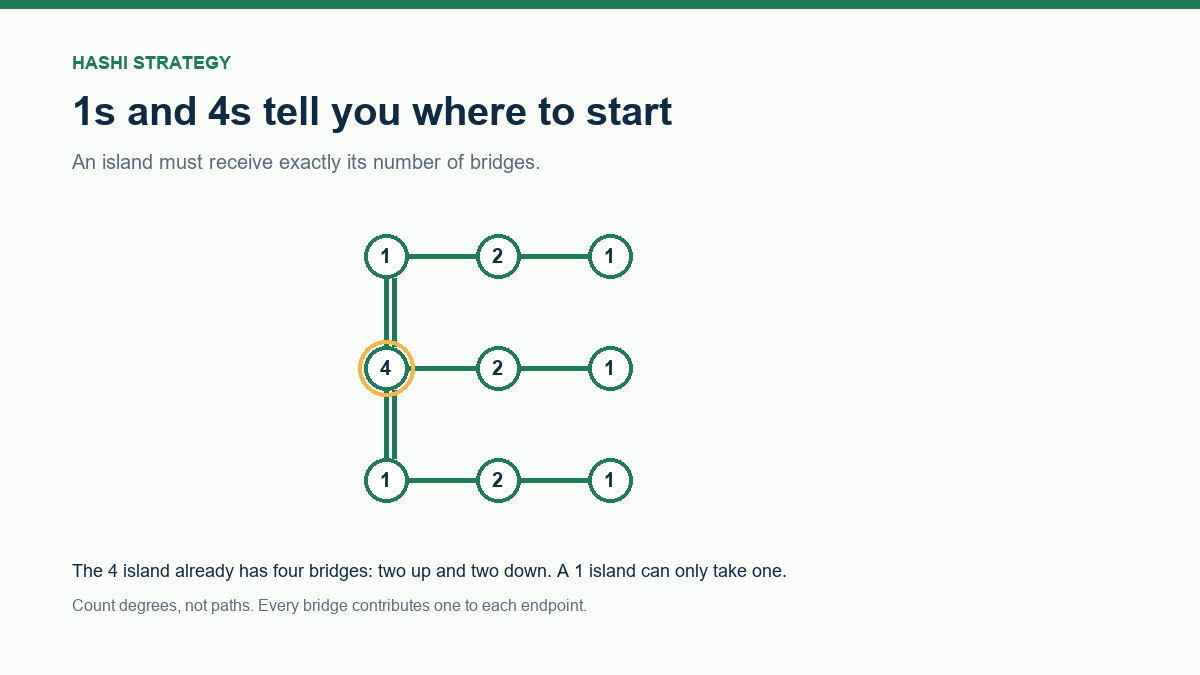
This is why a 1 is so powerful. A 1 island can have exactly one bridge end. If it has only one possible direction, that direction is forced. If it already has one bridge, every other direction must remain empty. A 4 island is the opposite: it needs four bridge ends, so it usually needs two double bridges or a combination of single and double bridges in different directions.
Use 1s and 4s first
A 1 on the edge of the board often has only one or two possible partners. If only one partner is reachable without crossing, the bridge is forced. A 4 in a corner needs all four possible bridge ends, which usually means two double bridges, or one double bridge plus two singles in different directions.
After placing a forced bridge, update the neighbour’s count. A 2 island that receives one bridge now needs exactly one more. A 3 island that receives two bridges now needs exactly one more. This propagation is the main solving loop.
Check crossings before committing
A bridge can only be horizontal or vertical. Before adding a long bridge, check whether it would cross an existing bridge. A horizontal bridge at row 3 from column 1 to column 5 crosses any vertical bridge in columns 2, 3, or 4 that spans row 3. If the intersection is at an island, the bridges meet at the island rather than cross, which is allowed; but an open intersection is not.
Crossings are the main reason a plausible-looking bridge is invalid. If a connection would cross, look for another route or a different bridge count.
Keep the network connected
It is possible to satisfy every island number and still fail because the bridges form two separate groups. After each deduction, ask whether the connected component you are building can still reach the rest of the islands. If a group is sealed off with no possible bridge to the outside, the position is invalid.
A useful habit is to build from a central cluster outward. Connect the 1s and 2s near the centre first, then expand. If a remote island has only one possible connection to the main group, that connection is forced.
A practical solving order
- Mark islands with only one possible partner.
- Place bridges forced by a 1 or a 4.
- Update neighbour counts and mark satisfied islands.
- Look for islands whose remaining count equals the number of available directions; place one bridge in each.
- Check for crossings before adding long bridges.
- At the end, verify that the network is connected.
Hashi in 2026: daily bridges and larger boards
Hashi rewards the same thing it always did: counting island demand and proving that a bridge cannot exist. The 2026 upgrade is presentation. Calccc Hashi includes Mini, Classic, and Daily boards, so the same logic can be a five-minute coffee break or a longer solve. The daily board is particularly useful for practising the no-crossing rule because the layout is fixed and comparable.
Start with islands that need all of their bridges, then mark the pairs that would cross. On the daily board, count total demand before drawing; an island with demand 1 is often the fastest first move.
Common mistakes
Counting bridges instead of bridge ends. A double bridge is two ends at each island. Forgetting the maximum of two. You cannot build three parallel bridges between the same pair. Allowing a crossing. Two bridges that intersect in an open cell are invalid. Leaving a separate component. Every island must be connected. Ignoring an island that is already satisfied. A satisfied island’s other directions must be empty.
Frequently asked questions
What are the rules of Hashi?
Connect islands with horizontal or vertical bridges. Each island must have exactly its number of bridge ends, no more than two bridges may connect the same pair, bridges may not cross, and all islands must be connected.
How do you use 1 and 4 islands in Hashi?
A 1 island needs exactly one bridge end, so if only one direction is available it is forced. A 4 island needs four bridge ends, so it often requires double bridges or multiple directions. Start with these extremes.
Can bridges cross in Hashi?
No. A horizontal bridge and a vertical bridge cannot intersect in an open cell. They may meet at an island, because that is a shared endpoint rather than a crossing.
Do all islands need to be connected?
Yes. The final network must be a single connected group. A solution with correct island counts but two separate groups is invalid.
Further reading