


Key takeaways
- No repeats inside a run. A sum of 3 in two cells can only be 1 + 2, never 1 + 1 + 1 or 2 + 1 with a repeated digit elsewhere.
- Two-cell runs are the best entry point. They have very few possible pairs, especially at the low and high ends.
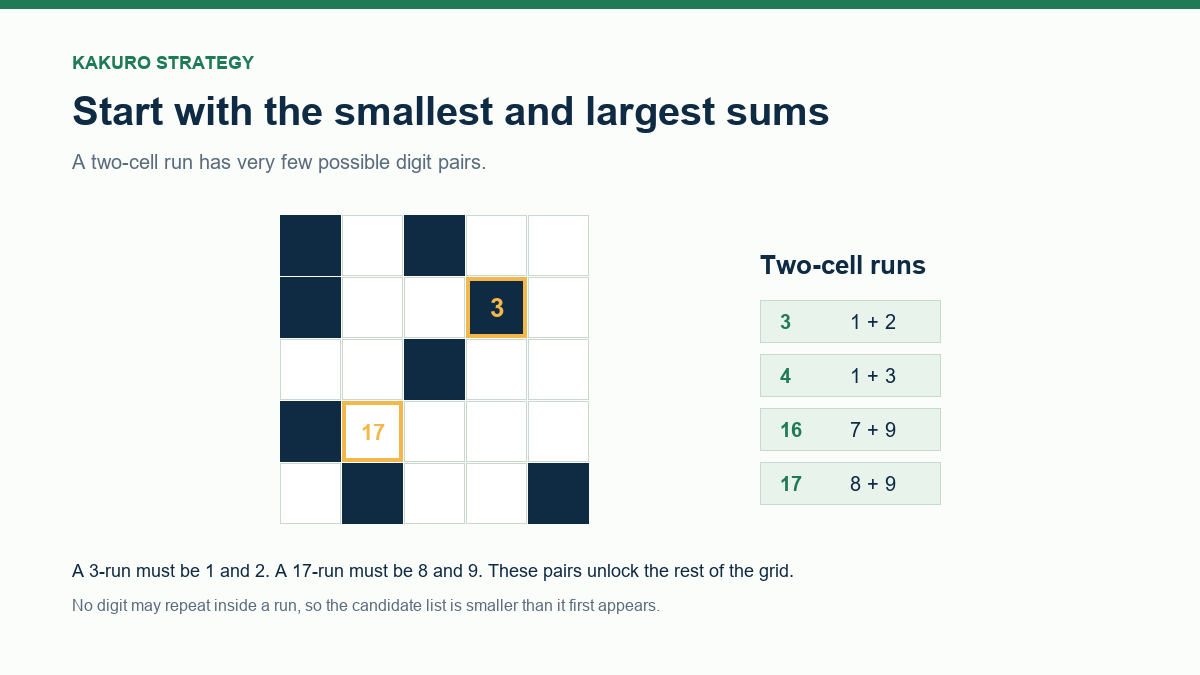
- Magic sums constrain candidates. 3 = 1+2, 4 = 1+3, 16 = 7+9, 17 = 8+9 for two-cell runs.
- Intersections do the heavy lifting. A digit placed in an across run changes the candidates in the down run that crosses it.
- Guess last. A well-formed Kakuro can be solved by deduction; if you are guessing, you have probably missed a forced pair.
What is Kakuro?
Kakuro is a number puzzle that looks like a crossword grid. Black cells contain clues; white cells are where you write digits. A clue in a black cell applies to the white run immediately to its right (an across clue) or immediately below it (a down clue). Some black cells contain both an across and a down clue.
The rules are short. Every white run must be filled with digits from 1 to 9. No digit may repeat within the same run. The digits in the run must add up to the clue. A white cell belongs to one across run and one down run, so the two constraints meet at every cell.
Why the no-repeat rule matters
Without the no-repeat rule, a two-cell run of 4 could be 1+3, 2+2, or 3+1. With the rule, 2+2 is impossible, so the only pair is 1 and 3. The rule removes many combinations and is the reason Kakuro is a logic puzzle rather than arithmetic trial and error.
For longer runs, the restriction is even stronger. A four-cell run with sum 10 cannot contain a repeated digit, so you are choosing four distinct digits from 1–9 that total 10. The smallest four distinct digits are 1+2+3+4 = 10. That means the run is forced: 1, 2, 3, and 4 in some order.
The magic sums to memorise
You do not need to memorise every combination, but the extremes are worth knowing. For two-cell runs:
| Clue | Only possible pair |
|---|---|
| 3 | 1 + 2 |
| 4 | 1 + 3 |
| 16 | 7 + 9 |
| 17 | 8 + 9 |
For three-cell runs, the smallest sum is 1+2+3 = 6 and the largest is 7+8+9 = 24. A clue of 6 or 24 therefore fixes the digits immediately, though not their order. A clue of 7 can be 1+2+4; a clue of 23 can be 6+8+9. The closer a sum is to the minimum or maximum, the fewer the possibilities.
How to start a Kakuro puzzle
- Scan for two-cell runs with extreme sums. 3, 4, 16, and 17 give you a pair immediately, even if you do not yet know which digit goes in which cell.
- Look for runs whose length and sum force the digit set. A four-cell run of 10 must be 1, 2, 3, 4. A three-cell run of 6 must be 1, 2, 3.
- Write candidates, not final digits. In a two-cell run of 3, mark 1/2 in both cells. The crossing run will eliminate one option.
- Use the crossing clue. If the across run forces a cell to be 1, the down run through that cell cannot use 1 anywhere else.
- Repeat from the most constrained cell. The cell with the fewest candidates is the next place to work.
A worked example
Suppose a two-cell across run has clue 3. The cells must be 1 and 2. The left cell also belongs to a down run with clue 17. A two-cell down run of 17 must be 8 and 9, so the left cell must be 8 or 9. But the across run only allows 1 or 2. The only way to satisfy both is impossible, which means the grid cannot have that combination — or, in a valid puzzle, one of the clues must be interpreted differently. This is why checking intersections early catches errors and eliminates branches.
In a valid puzzle, the intersection always has a digit that belongs to both candidate sets. If the across candidates are {1, 2} and the down candidates are {1, 8}, the cell must be 1. Once you place 1, the across run’s other cell is 2, and the down run’s other cell is 8. Three cells fall from one intersection.
Longer runs and candidate sets
For a run of length L, the minimum possible sum is 1+2+…+L, and the maximum is (10-L)+…+9. If the clue is close to either boundary, the candidate set is small. A run of five cells has a minimum of 15 and a maximum of 35. A clue of 16 is therefore extremely constrained: it is only one above the minimum, so the digits are almost the smallest five.
Write candidate digits in the corner of each cell if the interface allows notes. When a digit is placed in an across run, remove it from every other cell in that run. Do the same for the down run. The two reductions together are the core of Kakuro solving.
Kakuro in 2026: daily cross-sums and variant literacy
Kakuro sits between arithmetic and Sudoku, and the current puzzle audience is more comfortable with variants than it was a few years ago. Players now expect a daily board, a clear difficulty ladder, and a way to learn the sum combinations rather than memorise them. Calccc Kakuro includes Mini, Classic, and Daily boards, with the same run-sum logic across all three.
Learn the unique combinations first: 3 in two cells is 1+2, 4 is 1+3, and 16 in two cells is 7+9. On the daily board, mark candidates before filling a cell; the arithmetic is the easy part, the elimination is the puzzle.
Common mistakes
Repeating a digit in a run. This is the most common error; check every run, not just the row. Ignoring the down clue. A cell belongs to two runs; solving only the across direction will leave contradictions. Guessing a pair order too early. If a 3-run is 1 and 2, do not decide which is which until the crossing run forces it. Forgetting that a run can be a single cell. A one-cell run is allowed if the clue is 1–9; do not assume every run has at least two cells.
Frequently asked questions
What are the magic sums in Kakuro?
The most useful two-cell sums are 3 = 1+2, 4 = 1+3, 16 = 7+9, and 17 = 8+9. For longer runs, the minimum and maximum sums are also useful because they force the digit set.
Can digits repeat in a Kakuro run?
No. Each across or down run must use distinct digits from 1 to 9. The no-repeat rule is what makes the puzzle solvable by logic rather than arithmetic guessing.
What is the smallest possible Kakuro run?
A run can contain one cell. A one-cell run with clue 7 must contain 7. Two-cell runs are more common and are usually the best place to start.
Do I need to guess to solve Kakuro?
A well-formed Kakuro has a logical solution. If you are guessing, look for an extreme sum, a fully constrained run, or a cell with only one candidate after crossing out digits.
Further reading