


Key takeaways
- A number is exact. A 2 means two mines among its eight neighbours, not “about two”.
- Overlap creates deductions. If two numbers share neighbours, the difference between them often proves where a mine is.
- Flags are bookkeeping, not guesses. Flag a square only when the numbers force it.
- Clear safe squares after every flag. The board usually opens up in chains.
- Some endgames require a guess. When they do, compare probabilities instead of clicking at random.
Start with a safe first click
In the Calccc version, the first click is always safe: the mines are placed after you choose the first square, and the chosen square plus its neighbours are excluded. That gives you an opening region instead of an instant loss. Use the first click near the centre if you want a larger opening, because a centre square has eight neighbours and more chances to start a chain. A corner click is safer in a different sense, but it usually reveals less.
Once the board opens, the game becomes a constraint problem. You do not need to know where every mine is; you only need to prove the next safe square.
How to read a number
A 1 means exactly one of the eight surrounding squares contains a mine. A 2 means exactly two. If a number already touches the correct number of flags, every other covered neighbour is safe. This is the most common forced move in the game, and it is worth checking after every flag.
For example, a 1 with one flagged neighbour has no other mines. Every other covered square around it can be opened. A 2 with two flagged neighbours is the same. A 1 with no flags and only one covered neighbour means that neighbour is a mine. These are direct deductions, not guesses.
Use overlapping groups
The more powerful deductions come from comparing two numbers that share neighbours. Suppose a 1 and a 2 are adjacent, and the 2 covers every square the 1 covers plus one extra square. The 1 accounts for one mine in the shared group. The 2 needs two mines total, so the extra square must be a mine. That is a forced flag.
The same idea works in reverse. If a 2 and a 1 overlap, and the shared group can contain only one mine, the square that belongs only to the 2 must be the second mine. This is why experienced players talk about “difference” logic: subtract the smaller constraint from the larger one and look at what remains.
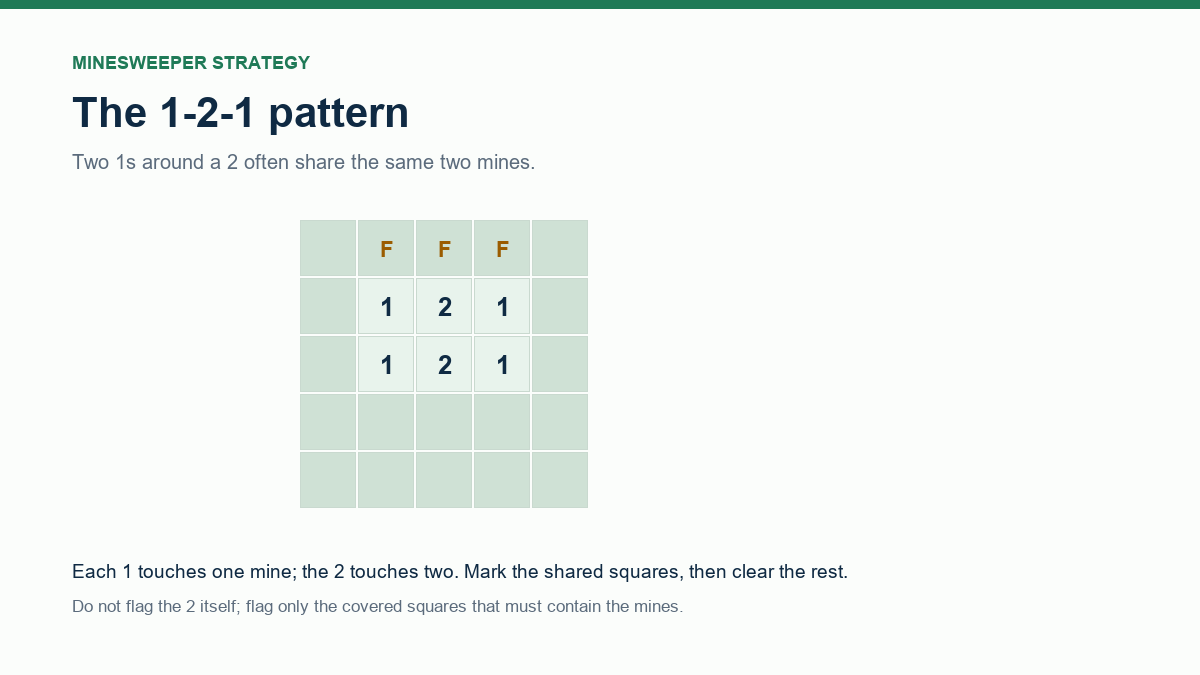
The 1-2-1 pattern
A common edge pattern is a row of 1, 2, 1. In the right alignment, the two 1s each need one mine, and the 2 needs two. The shared squares account for one mine, and the two outer squares are forced. This is a specific pattern, not a universal rule, so always check the actual neighbours instead of memorising the picture blindly.
The safe way to use a pattern is to write down the constraint. If the 1s have two covered neighbours each and the 2 has three, compare the sets. The squares that appear in both a 1 and the 2 cannot both be mines if the 1 already has its mine elsewhere. A small amount of set logic is more reliable than pattern matching.
Flag discipline
Flags are a visual aid, but they can also create false confidence. Do not flag a square just because it “looks like” a mine. If you flag a safe square, the numbers around it become misleading, and you may open a mine later. Flag only when a count forces the square, or when you are deliberately marking a probability for the endgame.
When a number is satisfied, clear the remaining neighbours immediately. This is the fastest way to make progress. A satisfied 1 can open up to seven safe squares; a satisfied 2 can open even more. The board often cascades after one correct flag.
When you have to guess
Not every Minesweeper board is solvable by logic alone. In the endgame, you may have two covered squares and one mine, with no number that distinguishes them. At that point, a guess is unavoidable. Do not guess early, though: check for a safe square first. A guess in the middle of the board can destroy a position that was still solvable.
If you must guess, compare the possible mine counts. A square that is a neighbour of several low numbers may have a lower probability than a square in a dense area. Some players also use the remaining mine count: if the board still needs many mines, a region with no flags is more likely to contain them. These are probabilities, not proofs, so treat them as a last resort.
Endgame checklist
- Are all satisfied numbers cleared?
- Is there a 1 with only one covered neighbour?
- Is there a 2 with two covered neighbours?
- Do two numbers overlap in a way that proves a square?
- Does the remaining mine count force a region?
- Only then, guess with the best probability.
The checklist is short because the logic is repetitive. Most of the game is applying the same three or four deductions to new regions.
Practice
The Calccc Minesweeper has Beginner 9×9, Intermediate 12×12, and Expert 16×16 modes. The first click is safe, and Flag mode makes touch devices usable. Start on Beginner and aim to finish without flags for the first few games; then add flags as bookkeeping. If you lose, look for the first place where you guessed instead of proving. That is the habit to remove.
Minesweeper in 2026: daily boards and no-guess expectations
Modern Minesweeper players expect two things: a fair opening and a board that rewards logic rather than a coin flip. No-guess variants have become a visible design goal, and daily boards make the same layout available to everyone. The Calccc Minesweeper now includes a Daily 9×9 alongside Beginner, Intermediate, and Expert. The first click is protected, so the opening is a real choice rather than a hidden lottery.
Use the daily board to practise the 1-2-1 and 1-2-2 patterns. If a position still requires a guess, note it and move on; the goal is to reduce guesses, not to pretend they never happen.
Frequently asked questions
What is the safest first move in Minesweeper?
Click a corner or an open area first. Calccc protects the first click and its neighbours, so the opening is a real choice rather than a hidden mine.
Is no-guess Minesweeper always possible?
Not every random board is solvable without a guess. No-guess variants are designed to avoid forced guesses; on a random board, flag uncertain cells and keep the position for later.
2026 variant: No-Guess 9×9
No-Guess mode rejects boards that cannot be solved with single-cell and flag deductions. The first click is safe, and a solver retries the mine layout until the opening is logically solvable. It is not a promise that every later position is trivial, but it removes the pure coin-flip openings that make classic Minesweeper frustrating.
Further reading