


Key takeaways
- Clues are run lengths, not counts. A clue of 3 means one run of three filled squares, not three separate squares.
- Overlap is the fastest first move. If a run is longer than half the line, some of its squares are forced.
- X marks matter. Marking empty squares prevents you from reusing space and makes the next deduction visible.
- Move between rows and columns. A row clue that looks stuck often becomes obvious after one column deduction.
- Guessing is a last resort. On a well-formed puzzle, every square can be proved from the clues.
What a nonogram clue actually means
A nonogram is a grid where each row and column has a list of numbers. The numbers are the lengths of consecutive filled squares, separated by at least one empty square. For example, a row clue of 2 1 on a 10-cell line means a run of two, at least one gap, then a run of one. The runs must appear in that order, but they can start anywhere in the line.
The important consequence is that the clue does not tell you where the runs start. It only tells you their sizes and order. Most beginner mistakes come from treating a clue as a fixed position, or from forgetting the mandatory gap between runs.
The overlap method
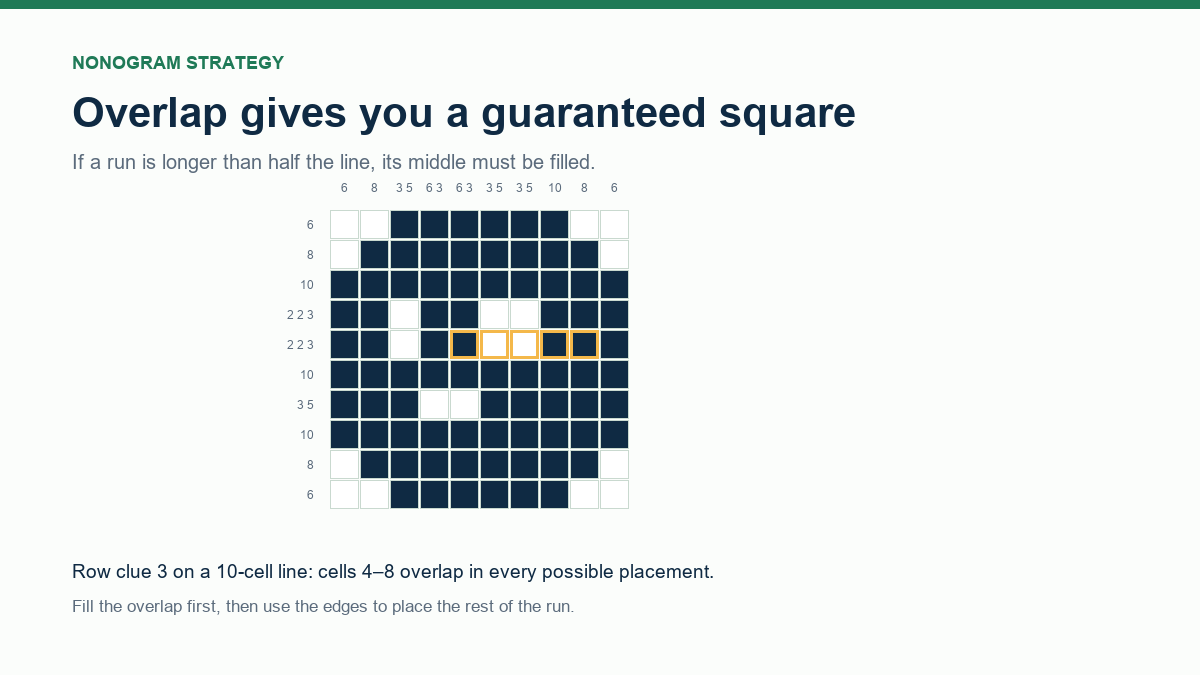
Take a row of 10 cells with a single clue of 6. The run can start at cell 1, cell 2, cell 3, cell 4, or cell 5. In every one of those placements, cells 5 and 6 are filled. Those two cells are forced, so you can fill them immediately.
The general rule is simple. For a run of length L on a line of length N, the number of possible starting positions is N – L + 1. If that number is smaller than L, the middle of the run must overlap. You do not need to memorise a formula for every puzzle; just compare the run length with the amount of free space. A run of 4 on a 7-cell line has four possible starts, so it does not force an overlap. A run of 5 on a 7-cell line has three possible starts, so its middle cell is forced.
With multiple clues, the same idea applies to each run, but the gaps also consume space. A useful habit is to count the minimum space the whole clue set needs: the sum of the runs plus one empty cell between each pair. If that minimum is close to the line length, the remaining slack is small, and the runs are tightly constrained.
Use the edges
The edges of the grid are powerful because a run that touches the edge has fewer possible positions. A clue of 3 at the start of a row either begins at cell 1 or later. If the clue set already accounts for most of the line, the run is pushed against one edge.
A common pattern is a full-length clue. A clue of 10 on a 10-cell line fills the entire row. A clue of 9 leaves one empty cell, and that cell can only be at one end. Once you know which end, the rest of the row follows. Similar logic applies to a 2-run at the edge of a short line: if the line is 5 cells and the clue is 4, the run must start at cell 1 or cell 2, which forces three cells in the middle.
Mark X early and often
Many players fill squares but never mark empty ones. That is a mistake. An X is a deduction too. If a run of 2 is already complete and the cells on both sides are outside the run, those cells must be empty. Marking them prevents you from placing another run there later.
X marks also make counting easier. When a row clue is 1 1 on a 10-cell line, the two single cells must be separated by at least one empty cell. If you know one of them is at the far left, the other cannot be adjacent. The X between them is part of the solution, not decoration.
Switch direction after every deduction
Nonograms are solved by alternating between rows and columns. A row deduction changes the information available to the columns, and a column deduction changes the rows. If you stare at the same row for a minute, you are probably missing a column clue that now has a forced square.
A practical loop is:
- Scan all rows for overlap and edge clues.
- Fill the forced squares.
- Mark the forced empty squares.
- Scan the columns with the new information.
- Repeat from the top.
This loop is boring on purpose. It is also how experienced solvers finish a 10×10 puzzle without guessing.
A short worked example
Suppose a 5-cell row has the clue 3. The run can start at cell 1, 2, or 3. No single cell is forced by overlap, because 3 is not greater than half of 5. But suppose a column clue tells you that cell 3 in that row is filled. The run of 3 must cover cell 3, so it can start at cell 1, 2, or 3. That still leaves three options, but now the column information can eliminate two of them. If another column says cell 1 is empty, the run cannot start at cell 1. If another says cell 5 is empty, the run cannot end at cell 5, so it cannot start at cell 3. The only remaining placement is cells 2–4. This is how small deductions combine.
Nonogram in 2026: daily boards and cleaner reading
Nonogram has moved from a niche paper puzzle into a daily browser habit. The useful upgrade is not a new rule; it is a cleaner loop: a small board to learn the notation, a daily board for a shared reference point, and a hint that explains the kind of deduction rather than simply filling a cell. The Calccc Nonogram now supports a Mini 5×5, Classic 10×10, and Daily 10×10, so you can practise the overlap method and then compare the same daily board with someone else.
Start with the Mini if clues such as 3 1 or 1 1 still feel opaque. Move to the Daily when you can solve a row without counting on your fingers. The 2026 trend is less about giant grids and more about a calm, repeatable daily solve.
2026 variant: Color 5×5
Color Nonogram uses two fill colours. Each row and column clue now has a colour as well as a run length. Runs of different colours do not merge, and the clue order matters. Start with the shorter colour runs, mark empty cells, and use the colour-specific clues to separate adjacent runs. The 5×5 board is deliberately small so the colour notation is easy to learn.
Common mistakes
Treating a clue as a block. A clue of 2 2 is two runs, not four cells in a row. The gap is mandatory. Forgetting that runs can touch the edge. A run does not need a gap outside the grid. Filling a square because it looks right. If you cannot explain which clue forces it, mark it as uncertain and keep deducing. Ignoring X marks. Empty squares are information. Restarting too early. A 10×10 puzzle often looks stuck for a minute before a column clue opens it up.
Practice with a real board
The Calccc Nonogram includes a 5×5 Mini, a 10×10 Classic, and a Daily 10×10. Start with the Mini to learn the clue notation, then move to the 10×10 and use the loop above. If you get stuck, use the Hint button once to see which kind of deduction you missed, then continue without it. The goal is not to finish quickly; it is to finish with a reason for every filled square.
Frequently asked questions
Is Nonogram good for beginners?
Yes. Start with the Mini 5×5; the run clues are short enough to check by hand. Move to 10×10 once overlap deductions feel natural.
Does Nonogram require guessing?
A well-formed nonogram can be solved by logic. If a position seems to require a guess, re-check the overlap and the empty-cell marks before trying a branch.
Further reading