


Key takeaways
- Not every arrangement is solvable. A parity rule decides which boards can reach the solved state.
- Solve in layers. Top row, then left column, then the smaller rectangle that remains.
- Do not disturb solved tiles. The empty square should stay inside the unfinished area.
- Use cycles, not random moves. A short loop can reposition a tile without destroying the row.
- Finish the last 2×2 as a unit. The final four tiles are a small puzzle of their own.
What makes a sliding puzzle solvable
A sliding puzzle has one empty square. Each move swaps the empty square with an adjacent tile. The order of the numbered tiles changes by a swap, so the parity of the permutation matters. For a 4×4 board, a configuration is solvable if the number of inversions plus the row of the blank square has the correct parity. A simpler practical rule: if you create the scramble by making legal moves from the solved board, it is always solvable.
That is why a random shuffle of the tiles is a bad generator. Half of the random arrangements are impossible to solve, and the player has no way to know until the end. The Calccc version scrambles by moving the blank legally, so every board is reachable from the solved state.
Solve the top row first
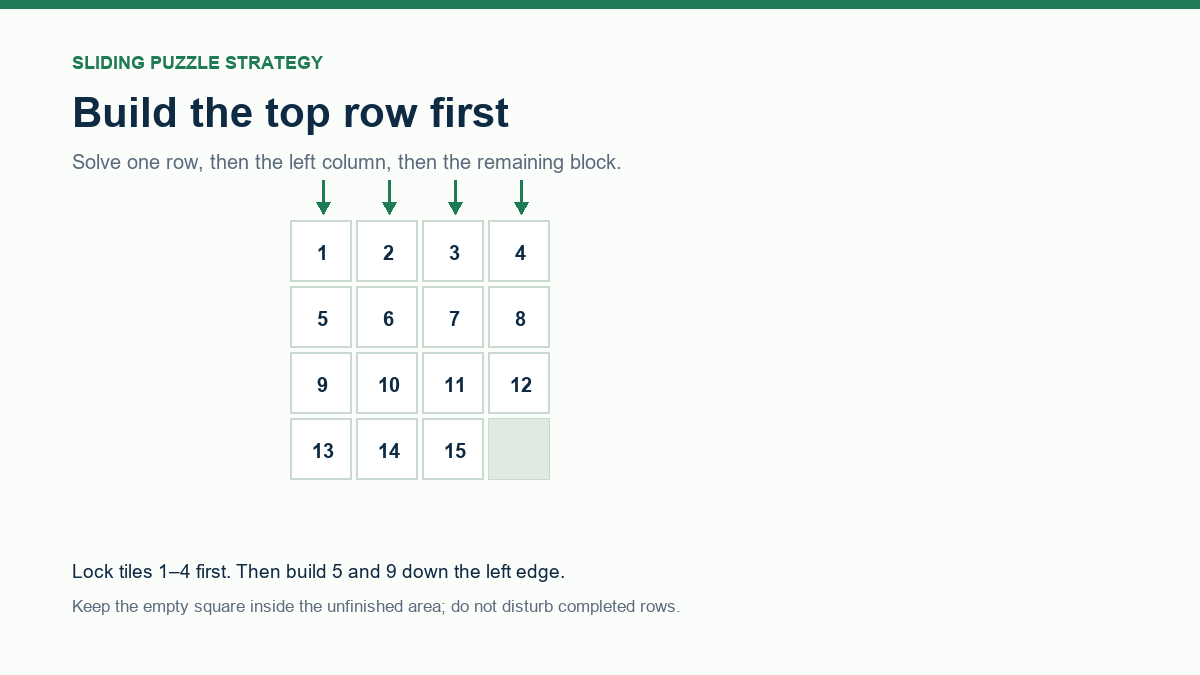
On a 4×4 board, the first goal is to place tiles 1, 2, 3, and 4 in the top row. Do not try to place all four at once. Place tile 1 in the top-left corner, then tile 2 next to it, then tile 3, then tile 4. If a tile is in the correct row but the wrong column, move it into the row and slide it sideways using the empty square.
The last tile of the row, tile 4, is the tricky one. You may need to move tile 4 into the top-right corner while temporarily moving tile 3 out of the way, then restore tile 3. This is normal. The completed row is not locked until all four tiles are in place; after that, do not move them again.
Then solve the left column
Once the top row is fixed, treat the remaining 3×3 area as a smaller puzzle. Place tile 5 directly below tile 1, then tile 9 below tile 5, then tile 13 in the bottom-left corner. Use the same technique: position the tile near its target, then rotate it into place with the empty square.
Do not move the top row while placing the left column. If a move would disturb tile 1–4, find a different route. The empty square should stay in the unfinished 3×3 region. If it wanders into the completed row, you will spend moves restoring the row.
The last 2×2
After the top row and left column are done, the remaining 2×2 block contains three numbered tiles and the empty square. This is a small rotation puzzle. You can solve it by cycling the three tiles around the empty square. If the last two tiles are swapped, the entire board is unsolvable; no amount of sliding will fix it. That is the parity rule showing up at the end.
A useful habit is to check solvability before you start. If you are playing a physical puzzle and the last two tiles are swapped, you need to take the tiles out and swap them back; sliding cannot do it. In the Calccc version, the scramble is generated legally, so the last two tiles will not be in the impossible state.
Use short cycles
A cycle is a sequence of moves that returns the empty square to its original position while changing the arrangement of a few tiles. Cycles are the building blocks of a controlled solution. Instead of pushing a tile randomly, move it around a small loop: up, left, down, right. That loop rotates three tiles and the blank, which is often exactly what you need.
On a 4×4 board, a 2×2 loop rotates three tiles. A 2×3 loop can reposition a tile along a row. The more loops you know, the less you need to improvise. But do not memorise dozens of sequences; learn the two or three loops that move a tile into a corner and out again.
Sliding Puzzle in 2026: daily boards and larger grids
The sliding puzzle is having a quiet revival as a short daily break. The 3×3 and 4×4 boards are familiar; larger grids and daily boards add variety without changing the rule. Calccc now offers 8 Puzzle, 15 Puzzle, 24 Puzzle, and a Daily board. The daily mode is a good test of the row-by-row method because you cannot restart into a different layout.
Solve the first row, then the first column, and keep the last two rows as a 2×3 sub-puzzle. On the daily board, write down the move count and try to beat it tomorrow.
Common mistakes
Chasing the last tile first. The bottom row is usually the last thing to solve, not the first. Moving completed tiles. A single move that breaks the top row can cost twenty moves to repair. Random shuffling. A random board may be unsolvable. Ignoring the blank. The blank is not empty space; it is the only tile you can move. Plan its path. Giving up on the last 2×2. If the last two tiles are swapped, the board is impossible; restart instead of wasting moves.
Practice
The Calccc Sliding Puzzle has 8 Puzzle 3×3, 15 Puzzle 4×4, 24 Puzzle 5×5, and Daily 4×4. Start with 3×3 to learn the loop, then move to 4×4 and solve the top row before touching the rest. Time yourself only after you can finish without breaking a completed row.
Frequently asked questions
What is the easiest sliding puzzle to start with?
Start with the 8 Puzzle 3×3. The row-by-row method is easier to see, and the board is small enough to undo a bad sequence.
Why does the last row get stuck?
The last two rows should be solved as one 2×3 block. Treating the final row independently often creates a cycle that cannot be resolved.
Further reading