


Key takeaways
- Push only. To move a box left, you must stand to its right.
- Corners are permanent. A box pushed into a corner can never leave.
- Order matters. The correct box may be the one farthest from its target.
- Undo is a tool. A wrong push is cheaper to undo than to repair.
- Small levels teach the most. Mini boards expose deadlocks quickly.
The basic move
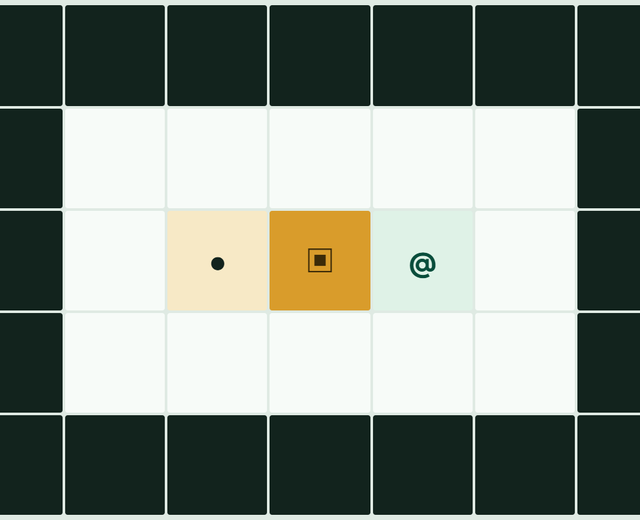
Walk into a box to push it one cell. You cannot pull, so the box always moves away from you. This single rule creates the whole puzzle: before every push, check where you will stand afterward and whether the box can still reach its target. A push that solves one box can block the only route to another.
Work backward from targets
Choose a target and imagine the box one cell away. Where must the player stand to push it in? Is that cell reachable without moving another box? If not, the box must approach from a different side. Working backward turns a crowded board into a set of short routes. On a board with two boxes, solve the box whose route is most constrained first.
Deadlocks
A box in a corner is dead unless the corner is its target. A box against a wall is dead if it can only move along the wall and its target is not on that line. Two boxes side by side against a wall can also lock each other. Before pushing, ask: “If this box cannot move again, is it already on a target?” If not, do not push it into that position.
Keep the player’s route open
It is easy to focus on the box and forget the player. After a push, the player is on the cell the box just left. If that cell is a narrow corridor, the player may not be able to reach the other side of the next box. Leave a wider route whenever possible. On small boards, the player’s position is often the real constraint.
Undo and reset
Use Undo after a push that creates a deadlock; it is faster than replaying from the start. Reset is for a bad opening plan, not for every mistake. If you reset repeatedly, write down the first three moves that worked and the point where the route closed. That is the lesson the board is teaching.
Daily and larger levels
Daily Sokoban uses the same level for everyone, which makes route comparison useful. On larger levels, count the boxes and targets before moving. If the counts differ, the board is invalid; if they match, decide which box has the fewest approach options. That box usually determines the order.
Route planning on paper
For a hard level, trace the player’s route with a finger before pushing. Mark the cell where the player must stand for each push, and check that the route to that cell does not cross a box. If the route crosses a box, you need to move that box first, which changes the order. This planning step is slower than a random push, but it prevents the most common restart.
Count the number of boxes and targets at the start. If a level has more boxes than targets, the extra box must be moved out of the way, not onto a target. If the counts match, the order is usually determined by the box with the fewest approach cells. That box is the bottleneck.
One push at a time
Before each push, name the target and the box. If the push does not move that box closer to that target, stop. This simple checkpoint prevents most of the casual deadlocks on small boards.
If a box can only be pushed along a wall, its target must be on that wall. Otherwise the box is already in a dead corridor.
If two boxes share a narrow corridor, solve the one nearer the exit first. Otherwise the second box can block the first box’s target.
Common mistakes
Pushing a box into a corner. It cannot be recovered. Solving the nearest box first. The nearest box may block the route to the harder one. Ignoring the player’s cell. A push can strand you on the wrong side. Resetting too quickly. Undo one move and inspect the position before starting over.
Practice
Play Calccc Sokoban Mini first, then Classic and Daily. On each level, say the target and the approach cell out loud before the first push. If you cannot name both, you are not ready to move.
Push, never pull
The player can only push boxes, not pull them. A box against a wall can only move along the wall; a box in a corner is stuck. Before pushing, check where the box will go and whether you can get behind it for the next push. The goal is to keep boxes away from corners unless the corner is a target.
Deadlocks
A box in a corner that is not a target is a deadlock. Two boxes against the same wall can block each other. A box pushed into a narrow corridor with no target may be unrecoverable. Learn the common deadlock shapes and undo early.
Planning
Work backward from the targets. Identify which box should go to which target, and in what order. Move the player around the box, not through it. The shortest path to a push is not always the shortest solution.
What to compare
Compare the push count, the moves, and the number of boxes on targets. Fewer moves is not always better if it creates a deadlock.
Frequently asked questions
Can you pull boxes in Sokoban?
No. You can only push. To move a box left, stand to its right and walk left.
What is a deadlock in Sokoban?
A deadlock is a position where a box can no longer reach any target. Corners and wall-trapped boxes are common deadlocks.
Further reading