


Key takeaways
- Think in rings. The cat needs a path to the edge; block the ring, not the cat’s current cell.
- Control the centre. A central cat has more routes; force it toward a wall.
- Keep the wall connected. A gap is an escape route even if it looks small.
- Do not overextend. A block far from the ring can waste a turn.
- Daily boards reward pattern recognition. Same cat start, same board, one attempt.
The board is a graph
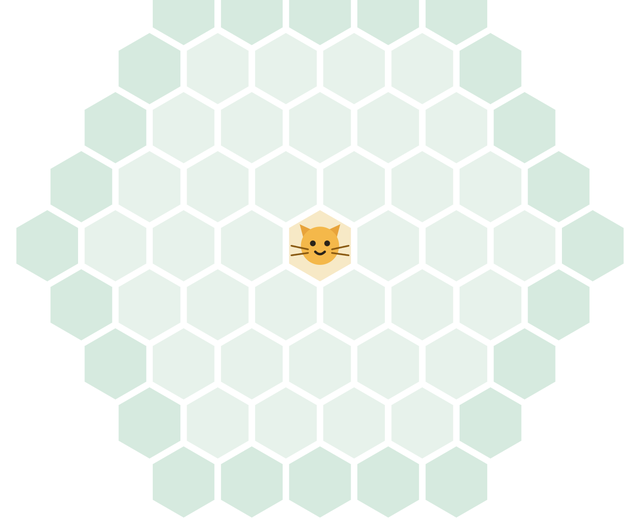
Each hex is a node and each shared edge is a connection. The cat can move to any adjacent hex that is not blocked. The edge of the board is the win condition for the cat. This is why a direct chase fails: the cat can always step sideways, and every step toward it may leave another route open.
Build a ring, not a line
A line of blocks can be walked around. A ring of blocks cannot. Start near the cat and extend the wall around it, keeping every new block adjacent to the existing wall. If the cat is near the centre, the first ring may be six hexes; if it is near a wall, a shorter arc may be enough. The shape matters more than the number of blocks.
Use the board edge as a wall
You do not need to block every direction. A hex on the edge of the board is already a boundary on one side. Use the existing boundary as part of the ring and spend blocks only on the open sides. This is the fastest way to reduce the cat’s routes without wasting turns.
Read the cat’s best route
The cat will move toward the nearest open edge. Count the number of moves from the cat to the edge through each gap. Block the shortest route first. If two routes are equal, block the one that also connects to a larger open region; that is the route with more future options. This is a minimax idea in miniature: reduce the cat’s best option, not its current position.
The endgame
When the cat is down to two or three adjacent cells, stop expanding and close the pocket. A common mistake is to keep placing blocks around the outside while the cat slips through the one gap you have not closed. Count the cat’s legal moves. If it has one, block it. If it has two, block the one that leads to the larger region.
Daily and challenge modes
Daily Trap the Cat uses a shared starting board, so the value is in comparing routes, not in grinding random boards. Challenge mode adds a constraint; read the mode description before placing the first stone. If a mode has a stone limit, every block must reduce the cat’s route count, not just look defensive.
Count routes, not stones
A useful habit is to count the cat’s legal moves after every placement. If the count stays the same, the stone probably did not affect the best route. If the count drops by two, you have closed a junction. Stones that reduce the count are worth more than stones that merely look close to the cat. This is why a block on the far side of the ring can be stronger than a block next to the cat.
On daily boards, replay the same position mentally after a loss. Identify the turn where the cat gained a new route. That turn, not the final escape, is the mistake. Challenge mode’s stone limit makes the same lesson sharper: every block must change the route count.
Practise the first ring
Set up a fresh Classic board and place only the first ring of blocks. Count the cat’s routes before and after. Reset and try a different first ring. Comparing two openings teaches more than finishing one board quickly.
Common mistakes
Chasing the cat. The cat can always move; the ring cannot. Leaving a diagonal gap. On a hex board, a gap is a legal route. Blocking far away. A distant block may be irrelevant while the cat walks out the other side. Ignoring the edge. The board boundary is free wall; use it.
Practice
Play Calccc Trap the Cat Classic, then try Daily for a fixed board. Before each block, ask: “How many routes does the cat have now, and how many will it have after this block?” That single question is the whole game.
Board control
Trap the Cat is a pursuit game on a hex board. The cat moves toward the edge; the player blocks tiles. The cat chooses a shortest path to an edge, so blocking the most direct route forces it sideways. Think in terms of cutting off escape routes, not chasing the cat.
Edges and parity
Edges are the cat’s goal. A block that does not reduce the number of escape routes may be wasted. Count the remaining paths to the edge after each block. Parity and turn order can decide who reaches a key tile first.
Common mistakes
Blocking tiles far from the cat; leaving a one-tile gap; and chasing instead of cutting off the route. Start near the cat’s shortest path, then close the alternatives.
What to compare
Compare the number of open escape routes and the cat’s distance to the edge. A block that reduces both is strong.
Frequently asked questions
How do you win Trap the Cat?
Close a connected ring of blocks around the cat before it reaches the edge of the board. Blocking routes is more important than chasing the cat.
Is Daily Trap the Cat the same for everyone?
Yes. Daily mode uses a seeded starting position, so the cat and the board are shared for that date.
Further reading