


Key takeaways
- Start with rare letters. Q, Z, X, J, and K appear less often, so they narrow the search.
- Use the word’s shape. A double letter or a repeated vowel gives you a pattern.
- Scan all eight directions. Words can run backward, vertically, and diagonally.
- Themed packs build vocabulary. Finance and math words repeat useful roots.
- Daily boards are comparable. Same grid, same list, one clean solve.
The brute-force trap
Reading every row left to right finds horizontal words and misses most of the board. A better method is word-first: take the first word on the list, choose its least common letter, find every occurrence of that letter, and check the eight directions. If the word contains a rare letter, the candidate set is tiny. If it contains only common letters, use the first letter and the word length instead.
Direction scanning
For a candidate cell, check all eight directions in a fixed order: right, left, down, up, down-right, down-left, up-right, up-left. A consistent order prevents double-checking the same path. For a long word, start at the rare letter and extend in both directions; the word may be written forward or backward. Do not assume the first letter is the start.
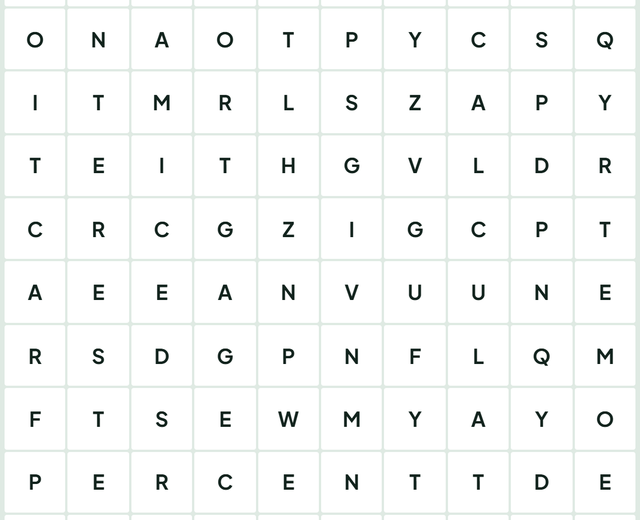
Use the word list as a checklist
Cross off each word as you find it. If two words share a prefix, such as CALC and CALCULATE, finding the shorter one can reveal the longer one. If a word is not appearing, check the reverse direction; a word written right-to-left looks very different from left-to-right. For diagonal words, trace with a finger or cursor so you do not lose the line.
Themed packs
Themed word search packs are a 2026-friendly upgrade because they combine vocabulary with a daily habit. A finance pack might include MORTGAGE, INTEREST, BUDGET, SAVINGS, CREDIT, INVEST, PROFIT, RATIO, TAX, and LOAN. Seeing the same roots across puzzles makes them easier to recognize and gives the puzzle a reason beyond random letters.
Daily Word Search
Daily Word Search uses a seeded grid and a fixed list. The daily format is useful for measuring scanning speed because the difficulty is constant. If you solve the Daily in five minutes, try the Classic 12×12 for more directions; if you are learning, start with Mini 10×10 and cross off words as you go.
Scan in strips
Instead of looking at the whole grid, scan a two-row strip at a time. Read the strip in both directions and look for the first two letters of each word. When you find a candidate pair, follow the eight directions before moving to the next strip. This reduces visual overload and makes diagonal words easier to spot because you are already looking at a narrow band.
Another useful habit is to search for the word’s last letter instead of its first. A word can be hidden backward, so the last letter may be the only one visible in a natural reading direction. For long words, the middle letters are often the easiest anchor: a repeated vowel or a rare consonant narrows the line quickly.
Themed packs are not just vocabulary practice. They train you to recognize roots such as MORT, CRED, and RATIO across different grids. That pattern recognition is the transferable skill; the specific word list is secondary.
Use a cursor, not a finger
On a screen, drag the cursor along the candidate line and read the letters aloud. The combination of visual tracking and sound catches reversals and diagonal shifts that a silent scan misses. Clear the selection before starting the next word so the highlight does not hide a letter.
For a diagonal word, say the row and column changes as you trace: down one, right one. The rhythm makes the line easier to keep.
If a word refuses to appear, check the reverse direction and the two diagonal slopes before moving on. Most misses are orientation errors, not missing words.
Use the word list as a checklist and tick each word off. A visible checklist prevents the “did I already find that?” loop.
Common mistakes
Only scanning left to right. Most words are not horizontal. Starting from the first letter every time. The rare letter is a better anchor. Losing the line on diagonals. Trace the path; do not jump cells. Ignoring the word list. The list is the constraint set, not decoration.
Practice
Play Calccc Word Search Mini 10×10, then Class 12×12 and Daily. For extra practice, use the Finance 10×10 pack and say each word’s meaning as you find it.
Scanning methods
Read the word list first, then scan for the first letter. Check all eight directions from each candidate. A systematic scan—rows, columns, then diagonals—is faster than random looking. For long words, look for distinctive letters and letter pairs.
Direction and overlap
Words can run forward, backward, vertically, horizontally, or diagonally, depending on the puzzle. Some puzzles allow overlaps or shared letters. If a word seems impossible, check the reverse direction and the diagonals.
Time management
Start with the longest or most distinctive words; they narrow the search. Mark found words and cross them off. If you are stuck, switch to a different section of the grid rather than staring at the same area.
What to compare
Compare the found words with the list and the grid. A word that appears by accident but is not on the list is not a solution.
Frequently asked questions
Can word search words run backward?
Yes. Words can run horizontally, vertically, or diagonally in either direction. Check the reverse direction before moving on.
What is the fastest way to find a word?
Start from the rarest letter in the word, then check all eight directions. Rare letters reduce the number of candidate paths.
Further reading